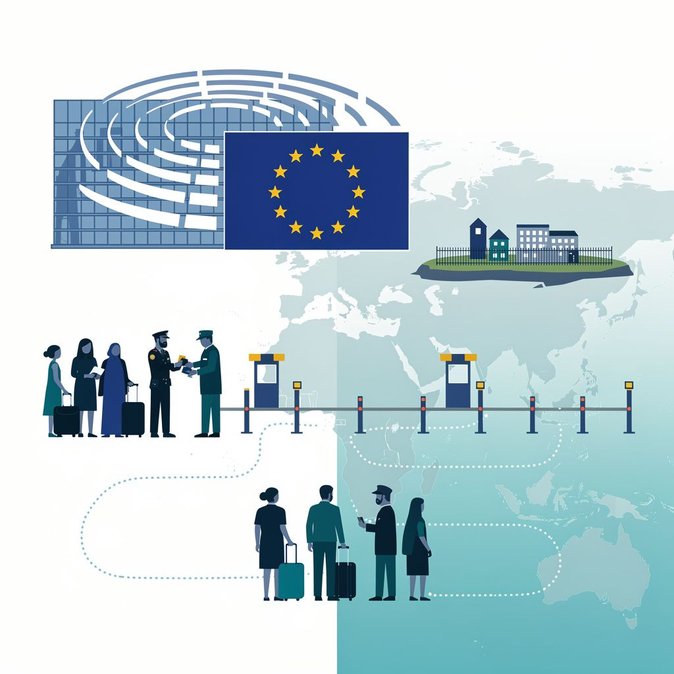
In a closely-watched vote in Strasbourg on 18 June 2026, Members of the European Parliament adopted the last piece of the bloc’s New Pact on Migration and Asylum: the “Returns Regulation”. The text grants national authorities broader powers to detain migrants who have no legal right to stay and, for the first time, explicitly allows Member States to transfer rejected asylum-seekers to processing centres in non-EU countries. Germany, together with Austria, Denmark, Greece and the Netherlands, had lobbied hard for the measure and confirmed after the vote that it is exploring potential partnerships for such centres in third countries. Interior ministry officials in Berlin argue that externalised procedures will speed up removals that currently succeed in fewer than 30 percent of cases and will deter secondary movements into the Schengen area. Critics counter that the plan risks creating legal “black holes” where EU standards and judicial oversight are hard to guarantee; German NGOs ProAsyl and Diakonie immediately announced they would challenge any offshore transfers in domestic courts. The government insists that the Charter of Fundamental Rights will apply and that only countries that have signed readmission and human-rights agreements with Brussels will be considered. For German employers the stakes are indirect but significant. The business community hopes that tougher action on irregular migration will make it politically easier for the coalition to expand legal labour-migration channels such as the EU Blue Card and the new points-based Opportunity Card. However, legal practitioners warn that prolonged detention powers (up to two years under the new rules) could clog administrative courts and absorb resources currently used for work-visa processing. Practically, anyone travelling on business to or through Germany after the regulation enters into force should expect stronger identity checks at land borders to continue. Although the Schengen Borders Code discourages internal controls, Berlin has already prolonged temporary checks until at least mid-September 2026; officials said the new Returns Regulation is "complementary" to that policy. Multinational companies are therefore advising employees to carry passports even on intra-Schengen trips and to build in extra time for potential stops. Looking ahead, EU governments still need to give a formal green light, but diplomats say this is a formality. Germany’s Interior Minister Alexander Dobrindt told reporters he wants the first bilateral accords on return hubs signed "before year-end" so that pilot facilities can be operational in 2027. If that timetable holds, corporate mobility managers will need to monitor how the choice of host countries affects duty-of-care obligations and assignment planning for staff posted to the region.
Source: The Local / The New Arab