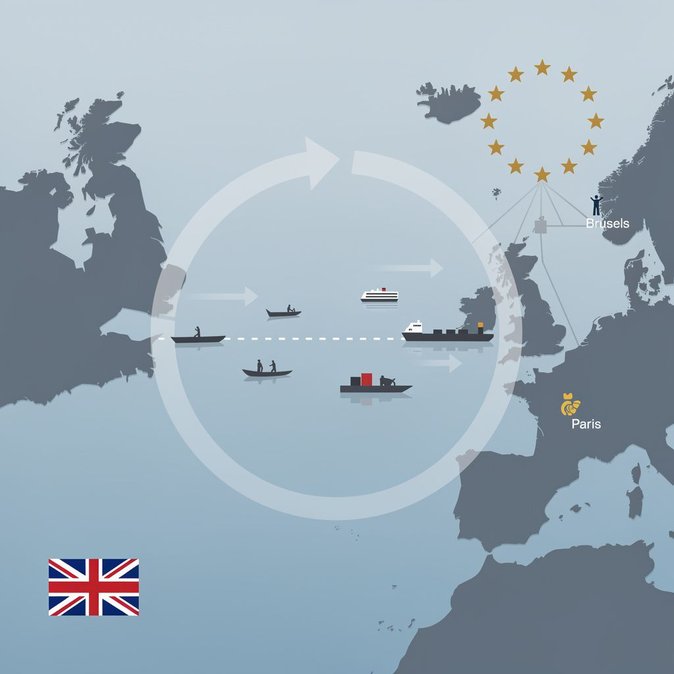
With the Franco-British ‘One in, one out’ returns agreement due to lapse in October, the European Commission on Tuesday unveiled a draft action plan treating Channel crossings as a pan-European challenge rather than a purely bilateral issue . France, Belgium, Germany and the Netherlands immediately endorsed the move, calling it “a first step towards a common strategy”. For London, the timing is awkward. The returns pilot has seen just over 1,100 migrants transferred back to France – barely 3 % of arrivals – yet the UK had budgeted €750 million for French border security from 2026-29 . If the pact ends, British ministers will need new mechanisms to deter small-boat crossings and reassure business travellers that Dover-Calais freight flows remain orderly.
The Commission’s plan focuses on diplomacy with transit countries, joint anti-smuggling operations and the possible deployment of additional Frontex personnel to France’s northern coast. Details are thin and southern EU states remain wary of formal readmission clauses, meaning any comprehensive UK-EU migration treaty is still distant.
For organisations and individuals needing to adjust quickly to any new visa or travel-document rules that may emerge from these talks, VisaHQ can simplify the paperwork. Its online portal (https://www.visahq.com/united-kingdom/) provides real-time guidance, streamlined application handling and courier options for Schengen, UK and other global visas, helping logistics firms and mobile staff stay compliant amid shifting border policies.
Logistics companies and mobility managers moving staff or goods through the Short Strait should monitor negotiations in the run-up to the 22 July UK-EU summit in Brussels. A failure to extend or replace the current deal could see French police redeployed inland, increasing beach departures and raising the prospect of disruptive ad-hoc UK port closures. In the meantime, carriers are advised to keep contingency plans – including rerouting via Dunkirk or Hook of Holland – under review and to brief internationally mobile staff on possible delays during peak summer travel.
The Commission’s plan focuses on diplomacy with transit countries, joint anti-smuggling operations and the possible deployment of additional Frontex personnel to France’s northern coast. Details are thin and southern EU states remain wary of formal readmission clauses, meaning any comprehensive UK-EU migration treaty is still distant.
For organisations and individuals needing to adjust quickly to any new visa or travel-document rules that may emerge from these talks, VisaHQ can simplify the paperwork. Its online portal (https://www.visahq.com/united-kingdom/) provides real-time guidance, streamlined application handling and courier options for Schengen, UK and other global visas, helping logistics firms and mobile staff stay compliant amid shifting border policies.
Logistics companies and mobility managers moving staff or goods through the Short Strait should monitor negotiations in the run-up to the 22 July UK-EU summit in Brussels. A failure to extend or replace the current deal could see French police redeployed inland, increasing beach departures and raising the prospect of disruptive ad-hoc UK port closures. In the meantime, carriers are advised to keep contingency plans – including rerouting via Dunkirk or Hook of Holland – under review and to brief internationally mobile staff on possible delays during peak summer travel.