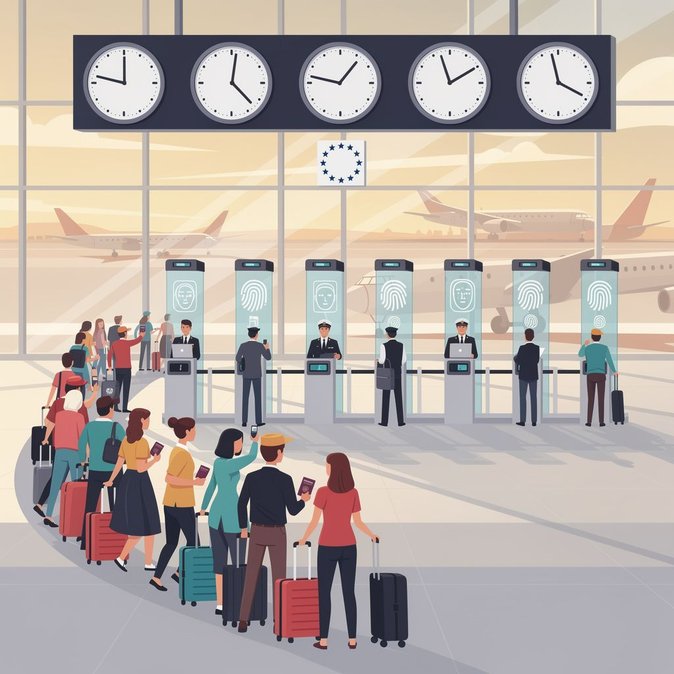
Rome’s two international gateways – Fiumicino (FCO) and Ciampino (CIA) – may temporarily shelve the EU’s new Entry/Exit System (EES) at the height of the June-September holiday rush. Aeroporti di Roma (AdR) chief executive Marco Troncone told the Financial Times, and later confirmed to Italian daily The Local, that the airports are already seeing enrolment queues of “two-to-three hours” for third-country passengers who must now provide fingerprints and a facial scan before entering or leaving the Schengen area. EES became mandatory in Italy on 10 April 2026 after an eight-month pilot at Fiumicino and Milan Malpensa.
To help travelers navigate these evolving border controls, VisaHQ offers an end-to-end visa and travel authorization service for Italy and the wider Schengen area. Their online platform (https://www.visahq.com/italy/) enables business-travel coordinators and individual passengers to pre-check documentation, book biometric appointments, and receive real-time alerts on EES and ETIAS developments, reducing last-minute surprises at the airport.
Under EU Regulation 2017/2226, member states can invoke a “flexibility mechanism” allowing six-hour suspensions when waiting times exceed 45 minutes. AdR says that without such relief the new process risks paralysing peak-season passenger flows and jeopardising airline on-time performance. No decree has yet been issued by the Italian government, but officials have told Brussels they are monitoring the situation daily. Business-travel managers should warn non-EU assignees and conference delegates that first-time biometric registration can still take 30–40 minutes even when queues are short. Frequent Schengen-area travellers who have already enrolled report clearance times similar to the old passport-stamp procedure. Companies may wish to stagger arrival times for large groups, budget extra dwell time, or route travellers via Milan, Venice or Bologna, where EES traffic is lighter. Airlines are also revising minimum-connection times for Rome because incoming non-EU passengers must clear EES before re-checking bags for domestic connections. In the longer term, AdR is fast-tracking 70 additional e-gates and deploying mobile enrolment teams in the arrival halls. The airports say full stabilisation should come once the EU’s companion ETIAS travel-authorisation system goes live in 2027, allowing most data to be pre-captured off-airport.
To help travelers navigate these evolving border controls, VisaHQ offers an end-to-end visa and travel authorization service for Italy and the wider Schengen area. Their online platform (https://www.visahq.com/italy/) enables business-travel coordinators and individual passengers to pre-check documentation, book biometric appointments, and receive real-time alerts on EES and ETIAS developments, reducing last-minute surprises at the airport.
Under EU Regulation 2017/2226, member states can invoke a “flexibility mechanism” allowing six-hour suspensions when waiting times exceed 45 minutes. AdR says that without such relief the new process risks paralysing peak-season passenger flows and jeopardising airline on-time performance. No decree has yet been issued by the Italian government, but officials have told Brussels they are monitoring the situation daily. Business-travel managers should warn non-EU assignees and conference delegates that first-time biometric registration can still take 30–40 minutes even when queues are short. Frequent Schengen-area travellers who have already enrolled report clearance times similar to the old passport-stamp procedure. Companies may wish to stagger arrival times for large groups, budget extra dwell time, or route travellers via Milan, Venice or Bologna, where EES traffic is lighter. Airlines are also revising minimum-connection times for Rome because incoming non-EU passengers must clear EES before re-checking bags for domestic connections. In the longer term, AdR is fast-tracking 70 additional e-gates and deploying mobile enrolment teams in the arrival halls. The airports say full stabilisation should come once the EU’s companion ETIAS travel-authorisation system goes live in 2027, allowing most data to be pre-captured off-airport.