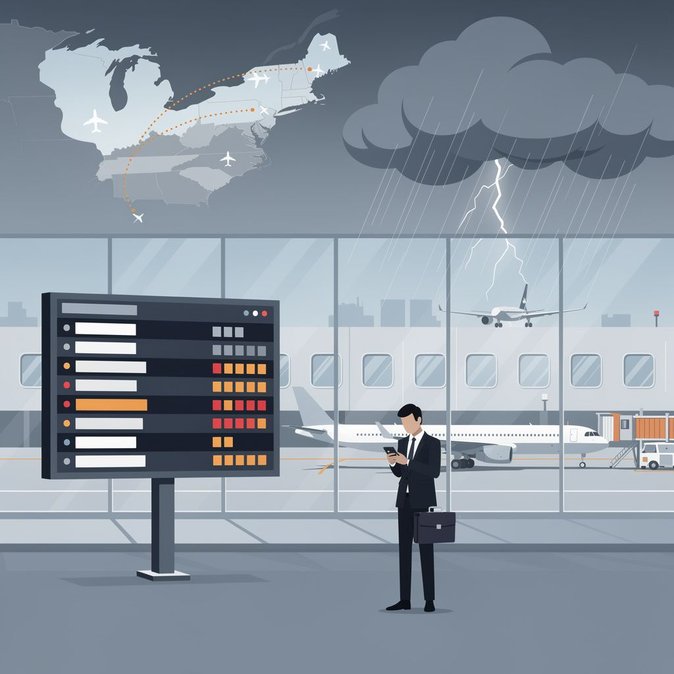
New York’s LaGuardia Airport (LGA) experienced 78 flight delays and two cancellations on Saturday, as afternoon thunderstorms collided with ongoing air-traffic-controller staffing shortfalls. The disruptions affected Delta, JetBlue, American, United and Southwest, forcing rerouting of aircraft and leaving hundreds of business travelers scrambling for hotel rooms in mid-Manhattan. Although the Federal Aviation Administration’s Command Center lifted its ground-delay program at 21:00 EDT, residual schedule knock-on effects spilled into Sunday morning, impacting first-wave departures to Boston, Chicago, Atlanta and Washington. Corporate travel desks reported a fivefold increase in rebooking requests, with some executives opting to ride Amtrak’s Northeast Corridor after calculating that train travel would deliver more reliable arrival times for Monday-morning meetings. The incident underscores the fragility of U.S. domestic aviation networks during peak season: LGA operates with limited runway capacity and is particularly vulnerable to weather.
![LaGuardia delays ripple across corporate travel itineraries as summer storms and staffing gaps converge]()
For international employees or visitors connecting through the United States, securing the right travel documents is equally critical. VisaHQ’s online platform simplifies the process of obtaining U.S. visas and other entry permits, offering real-time status updates and expert assistance (https://www.visahq.com/united-states/). By resolving paperwork well in advance, organizations can focus on contingency plans for operational disruptions like those at LaGuardia.
Global mobility teams moving assignees through New York should consider JFK or Newark for critical-timed travel and advise travelers to select flights earlier in the day when convective weather is less likely. Airlines are encouraging customers to use app-based self-service tools to change flights without fees, but same-day seat inventory is tight because carriers have scheduled at or near 2019 capacity levels. Companies with corporate-contract fare blocks may need to invoke waivers that allow access to higher fare classes when irregular operations occur. Looking ahead, the FAA plans to add 12 temporary controllers at LGA by mid-July and has asked airlines to voluntarily trim peak-hour operations by 10 percent—a measure that could reduce congestion but also limit seat availability. Mobility coordinators should watch for schedule changes and update ground-transport pickups accordingly.

For international employees or visitors connecting through the United States, securing the right travel documents is equally critical. VisaHQ’s online platform simplifies the process of obtaining U.S. visas and other entry permits, offering real-time status updates and expert assistance (https://www.visahq.com/united-states/). By resolving paperwork well in advance, organizations can focus on contingency plans for operational disruptions like those at LaGuardia.
Global mobility teams moving assignees through New York should consider JFK or Newark for critical-timed travel and advise travelers to select flights earlier in the day when convective weather is less likely. Airlines are encouraging customers to use app-based self-service tools to change flights without fees, but same-day seat inventory is tight because carriers have scheduled at or near 2019 capacity levels. Companies with corporate-contract fare blocks may need to invoke waivers that allow access to higher fare classes when irregular operations occur. Looking ahead, the FAA plans to add 12 temporary controllers at LGA by mid-July and has asked airlines to voluntarily trim peak-hour operations by 10 percent—a measure that could reduce congestion but also limit seat availability. Mobility coordinators should watch for schedule changes and update ground-transport pickups accordingly.