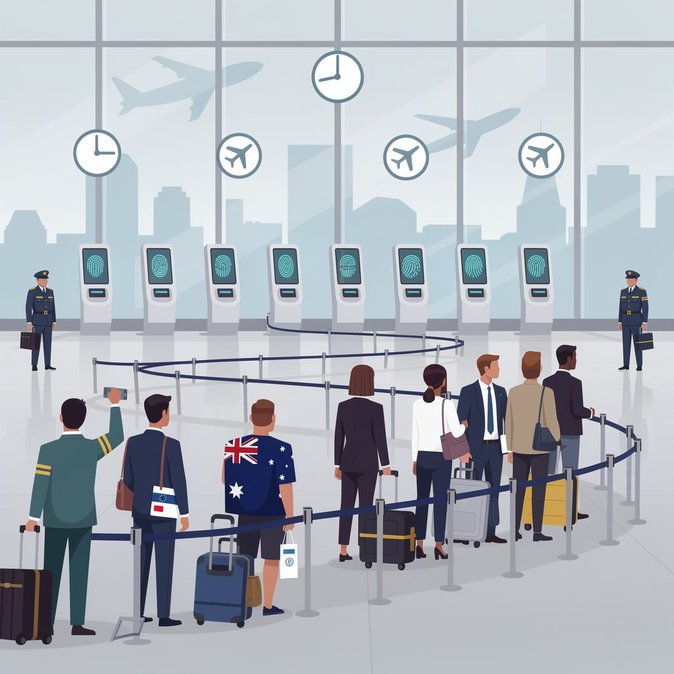
Australian business travellers touching down in Europe this week have run head-long into the European Union’s brand-new biometric Entry/Exit System (EES). Activated on 30 June 2026 across all Schengen external borders, the digital platform replaces the familiar ink-and-stamp routine with mandatory fingerprint and facial scans.
Australian passport holders juggling visas and new compliance rules need not navigate the maze alone. VisaHQ’s Australian portal (https://www.visahq.com/australia/) streamlines Schengen visa processing, tracks evolving EES and forthcoming ETIAS requirements, and offers live support—helping corporate travellers get the right clearances well before boarding.
While the change promises tighter border security and automatic overstay detection, its first 24 hours produced scenes of frustration at major hubs in France, Italy, Spain and Greece, with some Australians reporting immigration queues of more than three hours. Border-control officers now need several minutes per passenger to register first-time entrants, a workload multiplier when a wide-body flight of 350 long-haul passengers disembarks. Airport infrastructure—kiosks, e-gates and holding areas—has not yet scaled to match the new processing time, and staffing rosters were drawn up before the system’s true impact became clear. Mediterranean holiday gateways such as Rome-Fiumicino, Barcelona-El Prat and Athens International bore the brunt because peak northern-summer scheduling coincided with the day-one rollout. For Australian corporates the delays have practical and financial consequences. Missed rail connections, chauffeur no-shows and rescheduled client meetings are flowing through expense reports. Travel managers are already adjusting itineraries by adding buffer time or opting for first Schengen entry in better-equipped northern airports such as Amsterdam or Frankfurt. Airlines are revisiting minimum connection times for Schengen transfers because passengers without an EU passport can no longer rely on a quick manual stamp. EU agencies Frontex and eu-LISA say the pain will ease as repeat travellers sail through faster ‘verification-only’ lanes and as airports install more biometric kiosks. But Australian travel management companies (TMCs) warn the bedding-in period could last months, especially if staffing caps remain. They advise executives to pre-download documentation, fly on earlier services where possible and purchase fully flexible tickets. Some firms are even considering remote participation in European board meetings until the system stabilises. Longer term, the EES dovetails with the delayed ETIAS travel authorisation—now slated for 2027—which will shift most compliance tasks online before departure. Once both systems mature, Australians should enjoy faster automated processing on subsequent trips. In the meantime, patience, premium lounge memberships and meticulous scheduling have become essential accessories for any Australian doing business on the Continent in mid-2026.
Australian passport holders juggling visas and new compliance rules need not navigate the maze alone. VisaHQ’s Australian portal (https://www.visahq.com/australia/) streamlines Schengen visa processing, tracks evolving EES and forthcoming ETIAS requirements, and offers live support—helping corporate travellers get the right clearances well before boarding.
While the change promises tighter border security and automatic overstay detection, its first 24 hours produced scenes of frustration at major hubs in France, Italy, Spain and Greece, with some Australians reporting immigration queues of more than three hours. Border-control officers now need several minutes per passenger to register first-time entrants, a workload multiplier when a wide-body flight of 350 long-haul passengers disembarks. Airport infrastructure—kiosks, e-gates and holding areas—has not yet scaled to match the new processing time, and staffing rosters were drawn up before the system’s true impact became clear. Mediterranean holiday gateways such as Rome-Fiumicino, Barcelona-El Prat and Athens International bore the brunt because peak northern-summer scheduling coincided with the day-one rollout. For Australian corporates the delays have practical and financial consequences. Missed rail connections, chauffeur no-shows and rescheduled client meetings are flowing through expense reports. Travel managers are already adjusting itineraries by adding buffer time or opting for first Schengen entry in better-equipped northern airports such as Amsterdam or Frankfurt. Airlines are revisiting minimum connection times for Schengen transfers because passengers without an EU passport can no longer rely on a quick manual stamp. EU agencies Frontex and eu-LISA say the pain will ease as repeat travellers sail through faster ‘verification-only’ lanes and as airports install more biometric kiosks. But Australian travel management companies (TMCs) warn the bedding-in period could last months, especially if staffing caps remain. They advise executives to pre-download documentation, fly on earlier services where possible and purchase fully flexible tickets. Some firms are even considering remote participation in European board meetings until the system stabilises. Longer term, the EES dovetails with the delayed ETIAS travel authorisation—now slated for 2027—which will shift most compliance tasks online before departure. Once both systems mature, Australians should enjoy faster automated processing on subsequent trips. In the meantime, patience, premium lounge memberships and meticulous scheduling have become essential accessories for any Australian doing business on the Continent in mid-2026.