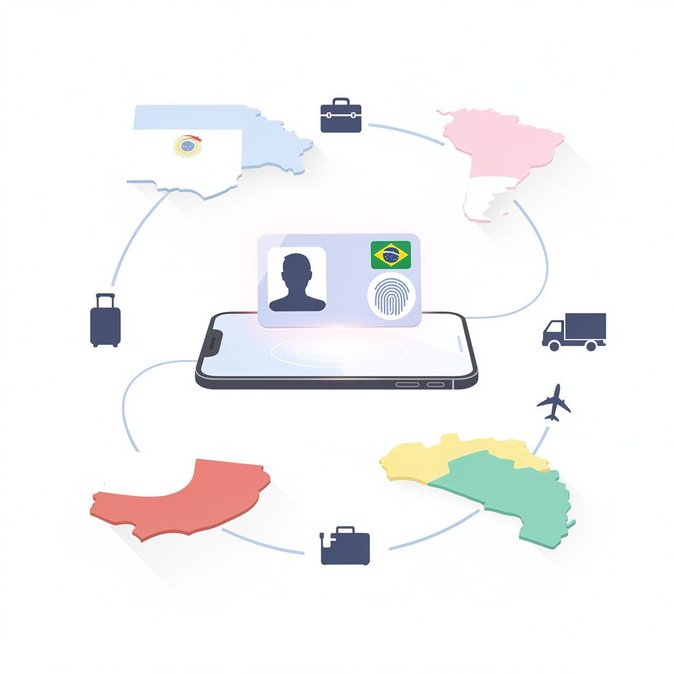
At the 68th Mercosur Heads of State Summit held in Asunción on 30 June 2026, President Luiz Inácio Lula da Silva and his regional counterparts approved a landmark protocol that recognises Brazil’s new Carteira de Identidade Nacional (CIN) as a valid travel document across the bloc and its associated members. The measure, expected to enter into force once each country completes internal ratification later this year, will allow Brazilian and neighbouring citizens to cross borders using the highly secure biometric ID card instead of a passport.
For travellers and mobility planners who want to understand how the CIN interacts with existing passport or visa requirements, VisaHQ can offer clear, up-to-date guidance. Its dedicated Brazil portal (https://www.visahq.com/brazil/) tracks regulatory changes across Mercosur, helps arrange any supplementary visas for onward journeys, and supports corporate travel teams with document processing and compliance.
The CIN, rolled out nationwide in 2023, consolidates tax, social-security and civil-registry numbers into a single, chip-enabled credential and is linked to the federal gov.br digital identity wallet. During the summit the presidents also signed a companion agreement on mutual recognition of electronic authentication systems—paving the way for mobile check-in kiosks at land crossings and faster e-gates at airports. According to Brazil’s Ministry of Foreign Affairs, the integration could reduce average document-control times at major checkpoints such as Foz do Iguaçu and Uruguaiana by up to 40 percent once fully implemented. For multinational employers, the ability for staff to circulate with the CIN rather than a passport simplifies short-notice trips to plant sites, branch offices or client meetings in Argentina, Paraguay and Uruguay. HR teams will no longer need to track passport validity for frequent intra-Mercosur travellers, and mobility managers expect cost savings on emergency passport renewals. Logistics and transport firms likewise anticipate faster truck clearance at border posts, improving just-in-time supply chains throughout the Southern Cone. The protocol also strengthens regional data-protection cooperation. Brazil’s “gov.br” single-sign-on will interoperate with Argentina’s “Mi Argentina” and Paraguay’s forthcoming “PyID,” enabling secure exchange of vaccination, driver-licence and tax-status information, subject to each country’s privacy rules. Authorities emphasised that only the minimal dataset needed for border control—name, nationality, and document validity—will be shared in real time. Next steps include publication of implementing decrees in each member state’s official gazette and technical testing of border infrastructure. Brazilian authorities aim to begin a pilot on the São Borja–Santo Tomé crossing in September 2026, with full roll-out across 25 land points and nine international airports by mid-2027. Companies with regional mobility programmes should review travel-policy language now to incorporate CIN usage and monitor forthcoming guidance on electronic authentication standards.
For travellers and mobility planners who want to understand how the CIN interacts with existing passport or visa requirements, VisaHQ can offer clear, up-to-date guidance. Its dedicated Brazil portal (https://www.visahq.com/brazil/) tracks regulatory changes across Mercosur, helps arrange any supplementary visas for onward journeys, and supports corporate travel teams with document processing and compliance.
The CIN, rolled out nationwide in 2023, consolidates tax, social-security and civil-registry numbers into a single, chip-enabled credential and is linked to the federal gov.br digital identity wallet. During the summit the presidents also signed a companion agreement on mutual recognition of electronic authentication systems—paving the way for mobile check-in kiosks at land crossings and faster e-gates at airports. According to Brazil’s Ministry of Foreign Affairs, the integration could reduce average document-control times at major checkpoints such as Foz do Iguaçu and Uruguaiana by up to 40 percent once fully implemented. For multinational employers, the ability for staff to circulate with the CIN rather than a passport simplifies short-notice trips to plant sites, branch offices or client meetings in Argentina, Paraguay and Uruguay. HR teams will no longer need to track passport validity for frequent intra-Mercosur travellers, and mobility managers expect cost savings on emergency passport renewals. Logistics and transport firms likewise anticipate faster truck clearance at border posts, improving just-in-time supply chains throughout the Southern Cone. The protocol also strengthens regional data-protection cooperation. Brazil’s “gov.br” single-sign-on will interoperate with Argentina’s “Mi Argentina” and Paraguay’s forthcoming “PyID,” enabling secure exchange of vaccination, driver-licence and tax-status information, subject to each country’s privacy rules. Authorities emphasised that only the minimal dataset needed for border control—name, nationality, and document validity—will be shared in real time. Next steps include publication of implementing decrees in each member state’s official gazette and technical testing of border infrastructure. Brazilian authorities aim to begin a pilot on the São Borja–Santo Tomé crossing in September 2026, with full roll-out across 25 land points and nine international airports by mid-2027. Companies with regional mobility programmes should review travel-policy language now to incorporate CIN usage and monitor forthcoming guidance on electronic authentication standards.