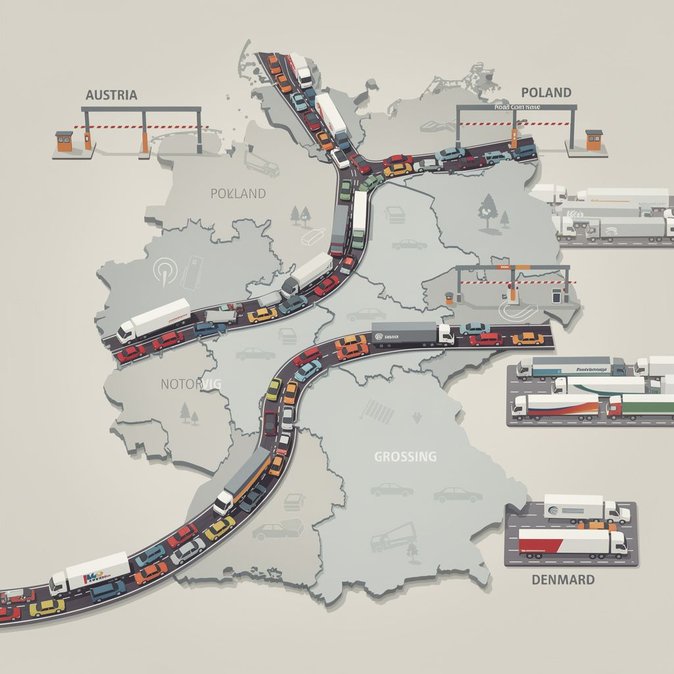
Germany’s automobile association ADAC has issued its traffic forecast for the weekend of 3–5 July, predicting “severe congestion” on Autobahns A1, A2 and A3 as six more Bundesländer start their school holidays. Beyond roadworks and heat-related “blow-ups”, the bulletin singles out reinforced border controls introduced in May 2025 as an additional delay factor. Checkpoints at Suben (A3, Austria), Walserberg (A8), Kiefersfelden (A93) and Ludwigsdorf (A4, Poland) are expected to cause tailbacks, with wait times also likely at Ellund (A7, Denmark). For mobility and relocation managers moving staff or project cargo across Germany’s land borders, the combination of holiday traffic and spot-checks poses scheduling challenges. Heavy-goods vehicles over 7.5 tonnes face the seasonal Saturday driving ban from 07:00 to 20:00, pushing more freight into weekday slots and raising the chances of overnight detention at borders. Companies should review delivery timetables and, where feasible, reroute via less-busy crossings. Business travellers driving from Germany to client sites in Austria, Czechia or the Netherlands should add at least 60–90 minutes to journey times and carry proof of meetings or residence to facilitate secondary inspections.
![ADAC warns of border-control bottlenecks as Germany enters second summer-holiday wave]()
To minimise paperwork-related holdups, travellers can turn to VisaHQ’s dedicated Germany hub (https://www.visahq.com/germany/), where interactive tools clarify visa and transit-document requirements for Austria, Czechia, the Netherlands and other neighbouring states. The service also alerts users to the latest border policies, allowing mobility coordinators to update staff instructions before wheels roll.
ADAC advises checking its real-time traffic portal before departure and forming an emergency lane (Rettungsgasse) as soon as traffic slows – failure to do so carries fines up to €320. The federal government has not indicated any immediate easing of the border regime, which was last extended until mid-September 2026. With further holiday departures looming, mobility teams may wish to shift critical meetings to virtual formats or arrange rail travel, which remains unaffected by land-border checks. In the medium term, logistics associations continue to lobby Berlin for more predictable controls or at least advance publication of targeted checkpoints, arguing that ad-hoc stops are costing the freight sector millions in idle time each month.

To minimise paperwork-related holdups, travellers can turn to VisaHQ’s dedicated Germany hub (https://www.visahq.com/germany/), where interactive tools clarify visa and transit-document requirements for Austria, Czechia, the Netherlands and other neighbouring states. The service also alerts users to the latest border policies, allowing mobility coordinators to update staff instructions before wheels roll.
ADAC advises checking its real-time traffic portal before departure and forming an emergency lane (Rettungsgasse) as soon as traffic slows – failure to do so carries fines up to €320. The federal government has not indicated any immediate easing of the border regime, which was last extended until mid-September 2026. With further holiday departures looming, mobility teams may wish to shift critical meetings to virtual formats or arrange rail travel, which remains unaffected by land-border checks. In the medium term, logistics associations continue to lobby Berlin for more predictable controls or at least advance publication of targeted checkpoints, arguing that ad-hoc stops are costing the freight sector millions in idle time each month.