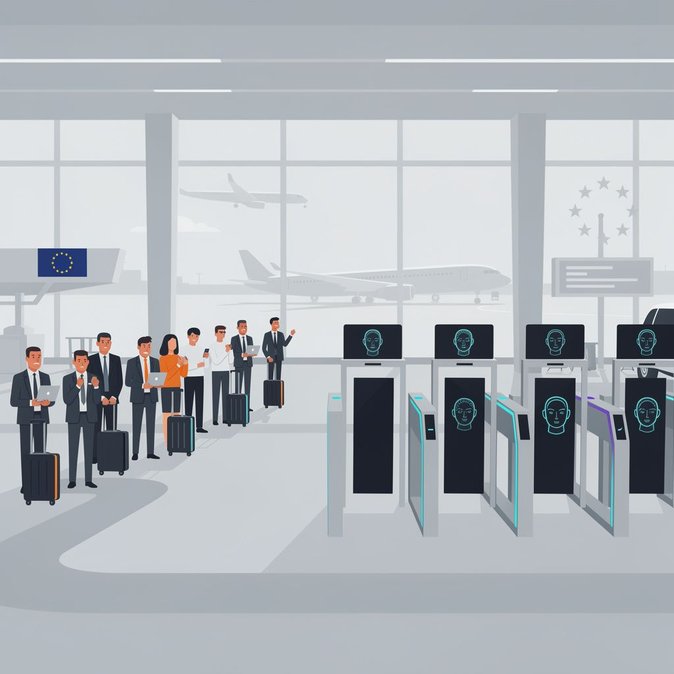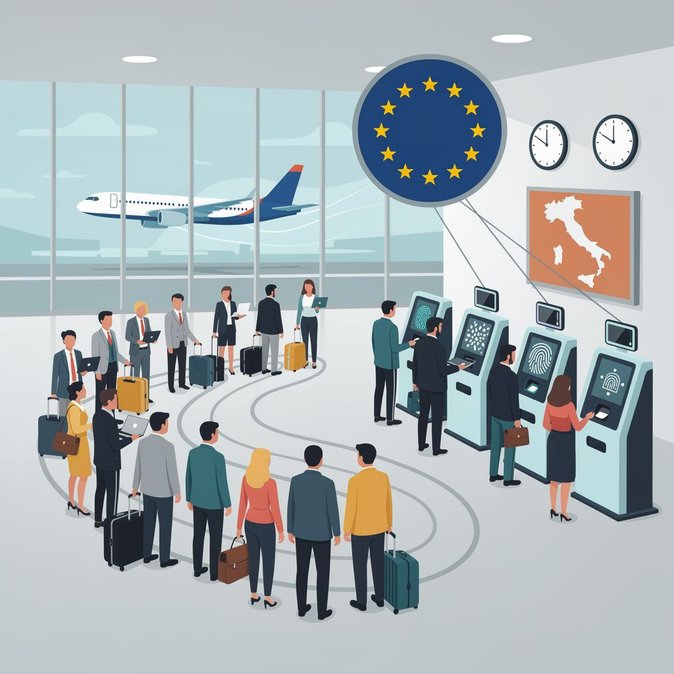
Low-cost giant Ryanair has fired the starting pistol on what it calls a “summer of queue chaos” caused by the EU’s new Entry/Exit System (EES). In an open letter to Brussels the carrier lists seven airports that are already struggling with the extra biometric checks; Milan-Bergamo is the only Italian hub on the list, but industry insiders say congestion at Rome-Fiumicino and Malpensa is only days away. The airline argues that infrastructure such as self-service kiosks and staffed booths is not yet adequate for peak-season volumes and urges the Commission to let Member States switch the system off temporarily whenever waiting times exceed capacity.
Introduced on 10 April 2026, the EES replaces the passport stamp for all non-EU travellers. First-time visitors must have four fingerprints and a live facial image captured; on subsequent trips the data are verified. Italy completed the system roll-out at its airports and ferry ports in mid-June, but border-police unions warn that they are still 800 officers short of what is required for July–August operations.
Ryanair’s call echoes a joint letter from Airlines 4 Europe, Airports Council International Europe and IATA that speaks of queues of up to five hours and planes leaving half-empty while passengers are stuck at passport control. The Commission has convened an emergency meeting for next week, but so far insists the system is “working as intended” and that suspension should remain a last resort.
For Italian businesses the timing could hardly be worse. Lombardy’s export-heavy SMEs rely on same-day hops to Germany and Spain; tour operators count on seamless weekend turnarounds; and Milan’s July fashion fairs expect 40 000 non-EU buyers. Longer queues translate into missed connections, lost perishables and higher overtime bills for handlers.
Amid the uncertainty, travellers and corporate travel departments looking to double-check visa or passport requirements before they even set foot in the airport can lean on specialist platforms such as VisaHQ. The company’s Italy portal (https://www.visahq.com/italy/) offers step-by-step guidance, document checklists and expedited processing options that cut down on last-minute surprises—providing an extra layer of reassurance while the EES teething problems are ironed out.
Travel-managers are advising passengers to allow at least an extra hour at departure and to pre-register passport data with carriers where possible. Practically, companies should: (1) stagger staff departures outside the 07:00-10:00 and 18:00-21:00 peaks; (2) use Fast-Track services at Bergamo and Malpensa, which remain outside Schengen control zones; and (3) brief travellers that children over 12 must also provide fingerprints. The Ministry of the Interior has published a dedicated EES FAQ page in English and Italian and says real-time queue data will soon be available via the “Viaggiare Sicuri” app.
Introduced on 10 April 2026, the EES replaces the passport stamp for all non-EU travellers. First-time visitors must have four fingerprints and a live facial image captured; on subsequent trips the data are verified. Italy completed the system roll-out at its airports and ferry ports in mid-June, but border-police unions warn that they are still 800 officers short of what is required for July–August operations.
Ryanair’s call echoes a joint letter from Airlines 4 Europe, Airports Council International Europe and IATA that speaks of queues of up to five hours and planes leaving half-empty while passengers are stuck at passport control. The Commission has convened an emergency meeting for next week, but so far insists the system is “working as intended” and that suspension should remain a last resort.
For Italian businesses the timing could hardly be worse. Lombardy’s export-heavy SMEs rely on same-day hops to Germany and Spain; tour operators count on seamless weekend turnarounds; and Milan’s July fashion fairs expect 40 000 non-EU buyers. Longer queues translate into missed connections, lost perishables and higher overtime bills for handlers.
Amid the uncertainty, travellers and corporate travel departments looking to double-check visa or passport requirements before they even set foot in the airport can lean on specialist platforms such as VisaHQ. The company’s Italy portal (https://www.visahq.com/italy/) offers step-by-step guidance, document checklists and expedited processing options that cut down on last-minute surprises—providing an extra layer of reassurance while the EES teething problems are ironed out.
Travel-managers are advising passengers to allow at least an extra hour at departure and to pre-register passport data with carriers where possible. Practically, companies should: (1) stagger staff departures outside the 07:00-10:00 and 18:00-21:00 peaks; (2) use Fast-Track services at Bergamo and Malpensa, which remain outside Schengen control zones; and (3) brief travellers that children over 12 must also provide fingerprints. The Ministry of the Interior has published a dedicated EES FAQ page in English and Italian and says real-time queue data will soon be available via the “Viaggiare Sicuri” app.