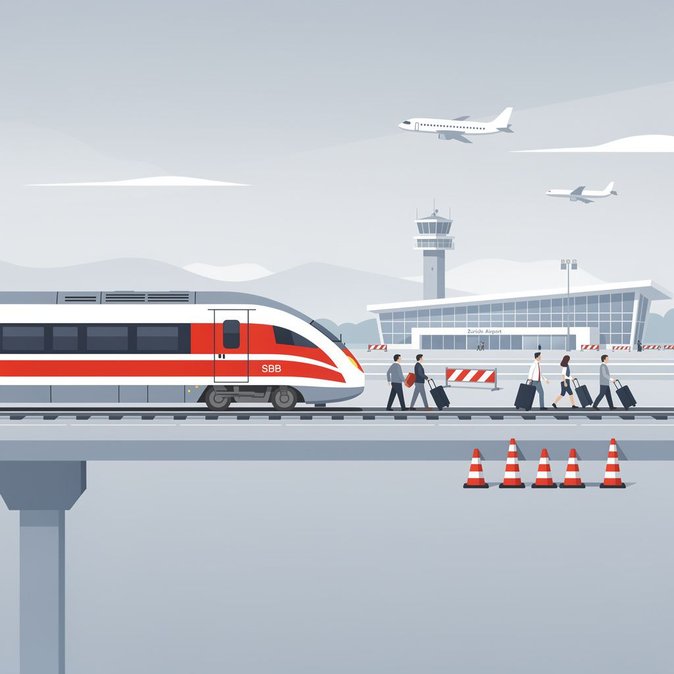
Swiss Federal Railways (SBB) has reopened the busy Oerlikon-Bassersdorf corridor on time, ending six weeks of diversions that had throttled rail capacity to Zurich Airport. According to the airport’s passenger-information page, the “rail service disruptions from 23 May to 3 July 2026” are now over, with long-distance and regional trains once again running on their normal paths.
For international visitors who will now find it easier to reach Zurich Airport by train, VisaHQ can help streamline the other part of the journey—border formalities. Whether you need a Schengen visa, are unsure about post-EES documentation, or just want to confirm transit rules, the company’s step-by-step online application tools and live support make it simple. Check your requirements and start an application at
During the works, many InterCity services from Basel, Bern and eastern Switzerland were rerouted or terminated at Zurich Hauptbahnhof, forcing travellers to switch to slower S-Bahn links or replacement buses for the final leg to the airport. Early-morning and late-evening trains were cancelled outright, prompting complaints from airlines about missed staff check-in times and from cargo shippers about tight overnight transfer windows. The CHF 230 million project replaced ageing track-bed, installed high-speed points and expanded overhead power capacity, all designed to raise the maximum number of hourly airport trains from 17 to 24 by 2030. Crucially, the upgrade also future-proofs the line for longer boarding times caused by the EU’s EES biometric controls, which Zurich Airport forecasts will push annual passenger numbers to 35 million. For business-mobility planners the return to normal timetables removes the need for taxi allowances and extended transfer buffers. Airline crew rostering, airport-hotel shuttle runs and air-rail through-ticketing products such as SWISS Air-Rail can now revert to pre-works lead times. SBB nevertheless recommends that travellers consult the online timetable for the next few days, as minor night-time finishing works may still trigger isolated platform changes. The successful completion underscores Switzerland’s practice of compressing disruptive rail engineering into short, well-publicised windows. Similar ‘blockades’ are scheduled on other airport approaches—including the Bözberg tunnel route to Basel—in autumn 2026, and companies relying on tight multimodal connections are already mapping alternative routings.
For international visitors who will now find it easier to reach Zurich Airport by train, VisaHQ can help streamline the other part of the journey—border formalities. Whether you need a Schengen visa, are unsure about post-EES documentation, or just want to confirm transit rules, the company’s step-by-step online application tools and live support make it simple. Check your requirements and start an application at
During the works, many InterCity services from Basel, Bern and eastern Switzerland were rerouted or terminated at Zurich Hauptbahnhof, forcing travellers to switch to slower S-Bahn links or replacement buses for the final leg to the airport. Early-morning and late-evening trains were cancelled outright, prompting complaints from airlines about missed staff check-in times and from cargo shippers about tight overnight transfer windows. The CHF 230 million project replaced ageing track-bed, installed high-speed points and expanded overhead power capacity, all designed to raise the maximum number of hourly airport trains from 17 to 24 by 2030. Crucially, the upgrade also future-proofs the line for longer boarding times caused by the EU’s EES biometric controls, which Zurich Airport forecasts will push annual passenger numbers to 35 million. For business-mobility planners the return to normal timetables removes the need for taxi allowances and extended transfer buffers. Airline crew rostering, airport-hotel shuttle runs and air-rail through-ticketing products such as SWISS Air-Rail can now revert to pre-works lead times. SBB nevertheless recommends that travellers consult the online timetable for the next few days, as minor night-time finishing works may still trigger isolated platform changes. The successful completion underscores Switzerland’s practice of compressing disruptive rail engineering into short, well-publicised windows. Similar ‘blockades’ are scheduled on other airport approaches—including the Bözberg tunnel route to Basel—in autumn 2026, and companies relying on tight multimodal connections are already mapping alternative routings.