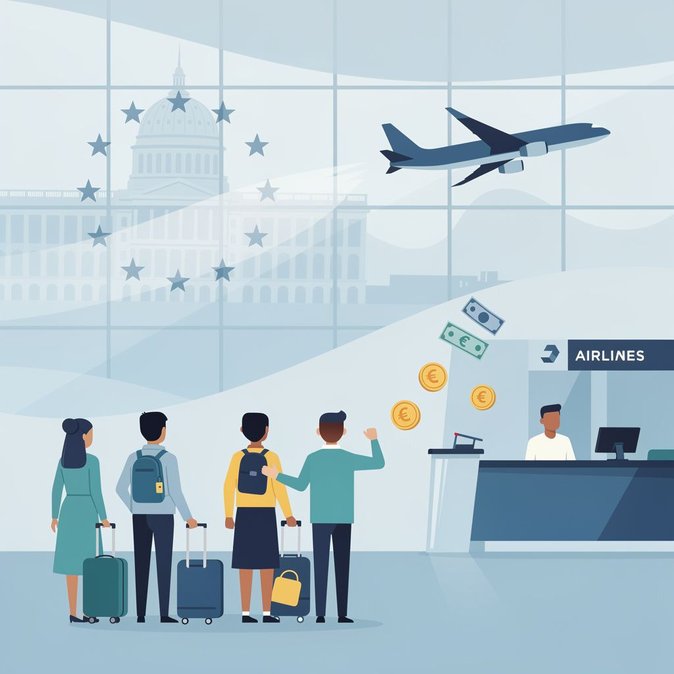
In a landmark vote in Strasbourg on 7 July 2026, Members of the European Parliament overwhelmingly approved sweeping revisions to Regulation 261/2004 – the cornerstone of EU air-passenger rights. After a decade of fraught negotiations with member states, the updated law cements a traveller’s right to bring one small carry-on bag (40 × 30 × 15 cm) on board at no extra charge and preserves cash compensation of €250–€600 for cancellations or delays of three hours or more.
Amid these forthcoming passenger-friendly perks, travellers should also ensure their documentation is in order. VisaHQ’s Ireland portal offers a one-stop online service to check visa requirements, arrange electronic travel authorisations and handle urgent passport renewals, helping both leisure and corporate flyers avoid last-minute snags while they capitalise on the refreshed Regulation 261 benefits.
For value-focused Irish travellers – who make up Europe’s highest per-capita users of low-cost carriers – the baggage clause is especially significant. Budget airlines such as Ryanair and easyJet have until now levied fees of €20–€35 for a standard wheel-aboard case. From 2027, Irish consumers booking through comparison sites must see an ‘all-in’ fare that already covers the free cabin bag, ending a long-running dispute between the airlines and the Competition & Consumer Protection Commission (CCPC) in Dublin. The new text also trims red tape around compensation. Passengers will have nine months (down from two years) to file a claim, but airlines must respond within 30 days, speeding up reimbursements that can be crucial for globally mobile employees fronting expenses. Names can be corrected on a booking free of charge, and digital boarding passes must be provided without forcing passengers to download proprietary airline apps – a boon for corporate travel managers migrating to single-sign-on solutions. Airlines warn that added obligations will increase costs. Ryanair’s group chief executive Michael O’Leary said the regulation “will ultimately push up ticket prices by €2–€4 per sector”, although analysts at Davy Stockbrokers argue that fierce competition on Irish routes will limit pass-through. Travel-policy teams should nonetheless budget for slightly higher average sector fares from 2027. With the regulation now awaiting Council rubber-stamping, Dublin’s Department of Transport confirmed it will amend Ireland’s Air Passenger Rights (Enforcement) Regulations within 12 months. Firms with high intra-EU mobility flows are advised to audit their duty-of-care processes and update traveller communication templates ahead of the 2027 go-live.
Amid these forthcoming passenger-friendly perks, travellers should also ensure their documentation is in order. VisaHQ’s Ireland portal offers a one-stop online service to check visa requirements, arrange electronic travel authorisations and handle urgent passport renewals, helping both leisure and corporate flyers avoid last-minute snags while they capitalise on the refreshed Regulation 261 benefits.
For value-focused Irish travellers – who make up Europe’s highest per-capita users of low-cost carriers – the baggage clause is especially significant. Budget airlines such as Ryanair and easyJet have until now levied fees of €20–€35 for a standard wheel-aboard case. From 2027, Irish consumers booking through comparison sites must see an ‘all-in’ fare that already covers the free cabin bag, ending a long-running dispute between the airlines and the Competition & Consumer Protection Commission (CCPC) in Dublin. The new text also trims red tape around compensation. Passengers will have nine months (down from two years) to file a claim, but airlines must respond within 30 days, speeding up reimbursements that can be crucial for globally mobile employees fronting expenses. Names can be corrected on a booking free of charge, and digital boarding passes must be provided without forcing passengers to download proprietary airline apps – a boon for corporate travel managers migrating to single-sign-on solutions. Airlines warn that added obligations will increase costs. Ryanair’s group chief executive Michael O’Leary said the regulation “will ultimately push up ticket prices by €2–€4 per sector”, although analysts at Davy Stockbrokers argue that fierce competition on Irish routes will limit pass-through. Travel-policy teams should nonetheless budget for slightly higher average sector fares from 2027. With the regulation now awaiting Council rubber-stamping, Dublin’s Department of Transport confirmed it will amend Ireland’s Air Passenger Rights (Enforcement) Regulations within 12 months. Firms with high intra-EU mobility flows are advised to audit their duty-of-care processes and update traveller communication templates ahead of the 2027 go-live.