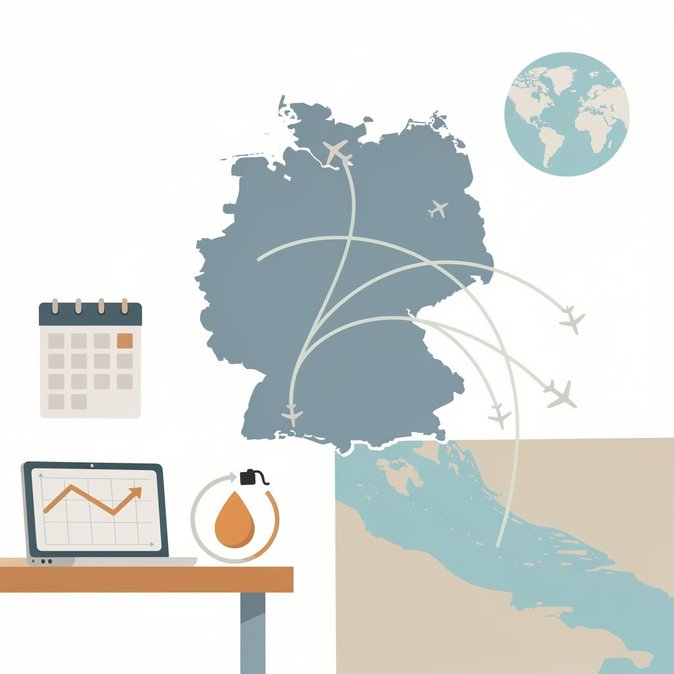
The latest monthly ifo Business Survey, published on 17 July 2026, shows that sentiment among Germany’s travel agencies and tour operators slipped for a second consecutive month. The travel-industry sub-index fell to –32.0 points in June from –30.3 in May and –15.6 before February’s Middle-East flare-up. According to ifo analyst Patrick Höppner, many German consumers postponed holiday decisions in the spring because of geopolitical uncertainty and then waited for last-minute summer deals. Behind the weaker headline figure is a clear split between European short-haul and intercontinental long-haul demand. Federal Statistical Office passenger data cited by ifo indicate that departures from German airports to Greece (+3.6 %), Croatia (+4.2 %) and Turkey (+2.7 %) were all higher year-on-year in the January–May period, while overall outbound air traffic shrank 0.2 %. Tour operators report that North-Africa packages and Far-East itineraries remain below pre-conflict levels, reflecting travellers’ heightened risk perception and higher insurance premiums. Price expectations have eased markedly: only a minority of firms now plan ticket surcharges for the autumn, as kerosene prices have fallen since May. That is welcome news for corporate-travel managers who saw double-digit airfare inflation earlier in the year; ifo calculates that EU intra-European fares were still 11.5 % above 2025 averages in the first half of 2026 but are now trending down. For mobility professionals the figures matter in two ways. First, they provide a forward indicator for Germany’s sizeable outbound MICE (meetings-incentives-conferences-exhibitions) segment: weaker confidence suggests that corporate demand for incentive trips and delegate travel could soften after the peak summer season. Second, they hint at potential late-season capacity swings as airlines adjust seat supply on Mediterranean routes while trimming long-haul frequencies. Companies with distributed project teams should therefore monitor autumn flight schedules and lock in fares early for intercontinental missions. In the medium term, ifo expects a rebound effect once the security situation in key long-haul markets stabilises. Employers planning 2027 assignments should assume that airfares will normalise but remain structurally about 5 % above the 2024 base because of sustainable-aviation-fuel surcharges and a tighter EU ETS cap.
Source: ifo Institute