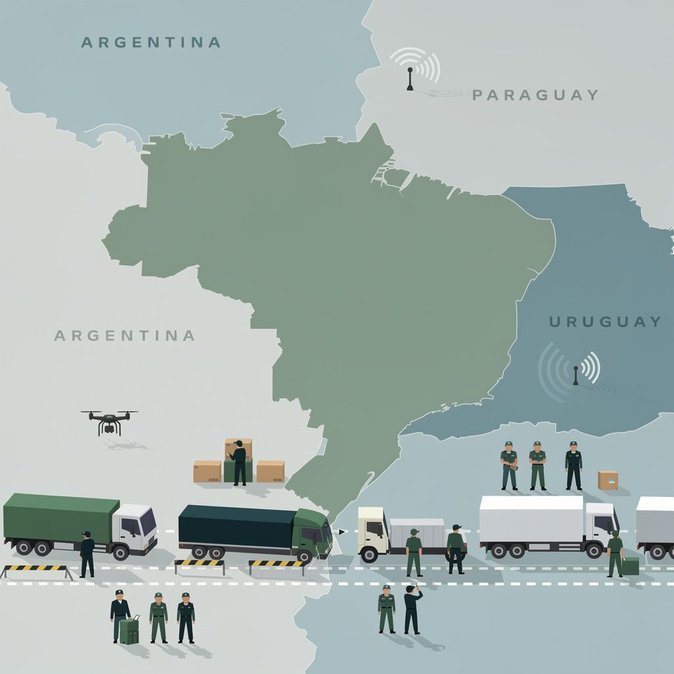
Brazil has launched a new phase of its long-running border-security initiative, Operation Ágata, mobilising more than 4,000 personnel across Paraná, Santa Catarina and Rio Grande do Sul. Announced on 22 July 2026 by the Joint Command “Tamandataí,” the Arco Sul-Sudeste edition concentrates on river crossings and secondary roads that smugglers use to ferry drugs, weapons and contraband from Argentina, Paraguay and Uruguay into Brazil’s industrial heartland. For the next ten days, army infantry, navy river-patrol units and air-force surveillance aircraft will work alongside the Federal Police, Receita Federal customs officers and state military police to set up checkpoints, conduct aerial reconnaissance and perform random cargo inspections. Environmental agencies such as Ibama and ICMBio have also joined to clamp down on illegal timber and wildlife trafficking, reflecting the operation’s growing environmental-security mandate. The border surge has immediate implications for cross-border supply chains. Truck turnaround times through the Tancredo Neves (Argentina) and Jaguarão (Uruguay) bridges are already up 40 percent, according to the Associação Brasileira de Transportes Internacionais. Companies shipping just-in-time components from Paraguayan maquila zones to factories in Santa Catarina should anticipate delays and adjust inventory buffers accordingly. Passenger traffic—particularly Paraguayans who shop in Foz do Iguaçu—will face more stringent document checks; Brazilian immigration booths have been temporarily reinforced to reduce queues. Operation Ágata forms part of the federal government’s Integrated Border Protection Programme (PPIF) created in 2011 but expanded in 2025 with new satellite-based surveillance tools. Defence analysts note that the 2026 edition is the first to deploy the SISFRON 2.0 tactical drones acquired earlier this year, providing real-time video feeds to command centres in Curitiba and Porto Alegre. The Ministry of Defence says performance metrics—seizures, arrests and environmental fines—will be published within 30 days of completion, enabling policy makers to gauge cost-benefit and plan the next phase covering the North-Central arc.
Source: SOT Notícias