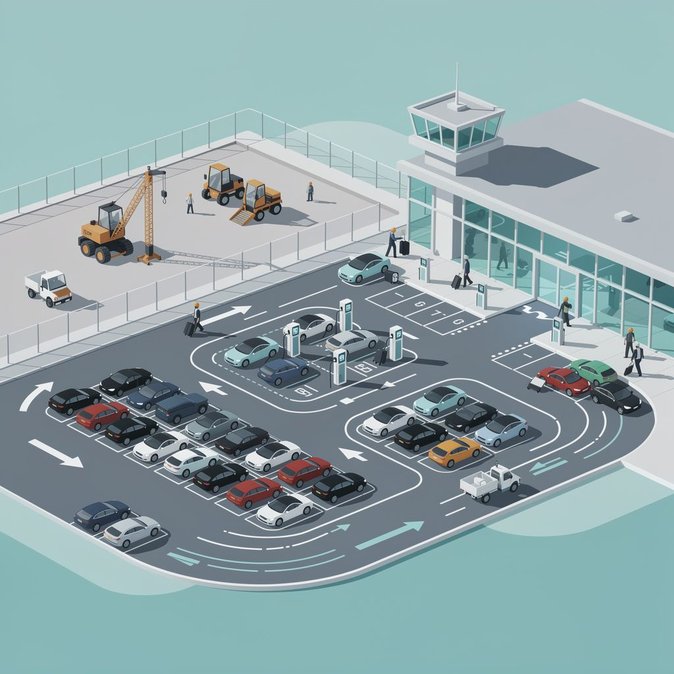
Aena, Spain’s state-owned airport operator, has launched a €5 million tender to overhaul the public car park at Seve Ballesteros–Santander Airport. Published on 27 July, the procurement covers resurfacing 36,000 m², widening access roads and adding more than 120 new parking bays—an 11 % increase—to cope with record summer traffic on Spain’s northern coast. The project is part of Aena’s wider strategy to squeeze incremental capacity out of regional airports while major expansions at Madrid-Barajas and Barcelona-El Prat remain under environmental review. Santander handled 1.3 million passengers in 2025—still small by Spanish standards but double its pre-pandemic volume. Low-cost carriers have flocked to the airport thanks to tourism growth in Cantabria and the Basque hinterland, leading to chronic congestion at peak weekend turnover times. Under the 15-month works programme the car park will gain new EV-charging points, shaded canopies and fully accessible pedestrian walkways. Construction will be phased so that at least 70 % of spaces remain available—critical for mobility managers who rely on rental-car fleets for regional assignments. Aena says contractors must maintain digital way-finding signage and real-time occupancy data to help drivers locate the nearest open bay, reducing circulation time around the terminal curb. The investment also aligns with Spain’s latest Sustainable Mobility Law, which requires airports with more than one million annual passengers to provide secure bicycle facilities and dedicated zones for ride-share pick-ups. Although Santander falls just short of that threshold, Aena will add a small bike lot and designate a ride-hail staging area to future-proof the infrastructure. For corporate travel planners the key message is continuity: parking prices will remain frozen during construction, and access roads will stay open, albeit with periodic lane shifts. Those managing VIP or air-crew transport should pre-book premium bays well in advance, as these will be the first to close temporarily when surfacing work reaches the terminal frontage.
Source: Cadena SER