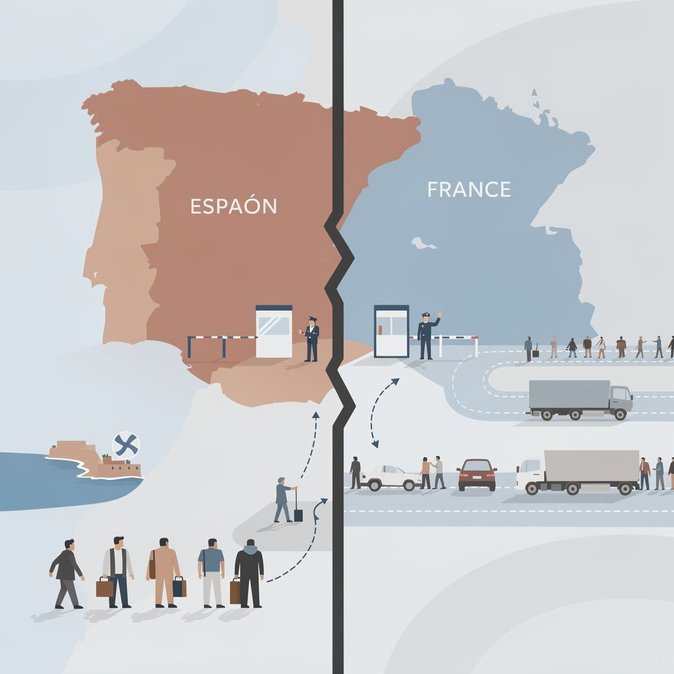
France moved swiftly this weekend to reinforce passport and security checks at its Pyrénées-Orientales and Basque border posts after an estimated 60,000 people entered the Spanish enclave of Ceuta from Morocco in just 24 hours. Interior Minister Laurent Nuñez told reporters that additional mobile patrols and fixed checkpoints would be deployed on major road, rail and coastal routes linking Catalonia and the south-west of France. The measures are designed to deter secondary movements of migrants who may try to depart Spain for other EU states. The extraordinary influx, which overwhelmed Spanish authorities on Friday, prompted Italy to re-introduce air and maritime controls with Spain and sparked calls from several EU capitals—including Copenhagen and Helsinki—for an unprecedented, temporary suspension of Spain’s participation in the Schengen free-movement area. While that drastic step would require a formal proposal from the European Commission and the approval of member states, the debate has thrown a spotlight on long-standing grievances about the way the bloc shares responsibility for sudden migration crises. French officials emphasise that Paris has kept land-border checks in place since the November 2015 terrorist attacks, citing terrorism threats, cross-border crime and irregular migration. Those controls have already been rolled over more than two dozen times, drawing criticism from Brussels but remaining legal under the Schengen Borders Code’s public-security exemption. The Ceuta episode, they argue, underscores the need for “proportionate but flexible” national powers when external EU borders falter. For business travellers and cross-border commuters the immediate impact is longer queues at the Perthus and Biriatou crossings, random ID checks on high-speed trains between Barcelona and Paris, and possible delays for lorries hauling just-in-time cargo. Companies moving staff between French and Spanish sites are being advised to factor in extra journey time and ensure that non-EU employees carry both passports and valid residence permits to avoid secondary inspection. In the medium term, relocation managers should monitor whether the Commission launches an evaluation of Spain’s external-border management or of France’s prolonged internal checks; either action could lead to new compliance obligations or, conversely, a tightening of intra-Schengen travel rules. The episode is also likely to revive pressure for a long-stalled reform that would allow the EU to deploy standing border guards more rapidly when a member state faces an acute influx.
Source: Euronews