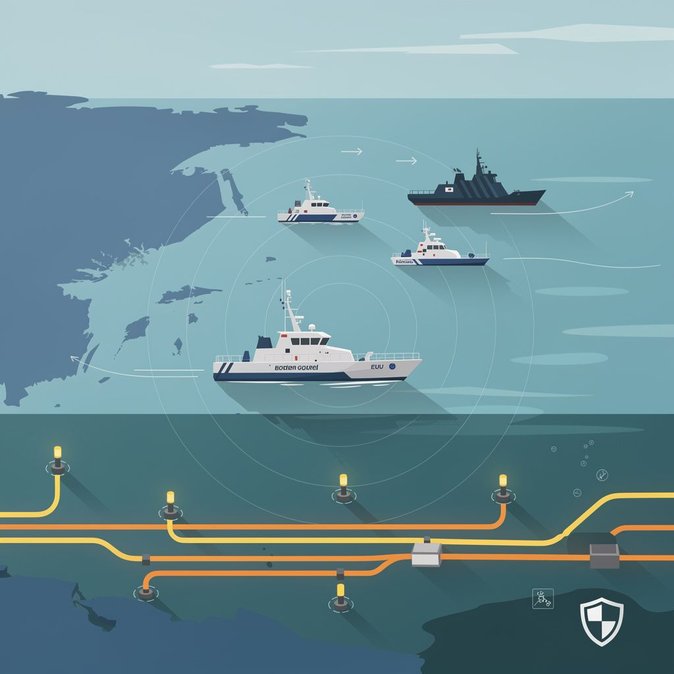
The Finnish Border Guard capped a week-long multinational exercise on 19 September 2026 that stress-tested how European agencies would protect critical underwater infrastructure (CUI) – pipelines, power cables and data lines – running through the Gulf of Finland. Branded “MARSEC EU 26”, the drill brought together 300 specialists from Finland, Poland, Sweden and EU bodies Frontex and the European Maritime Safety Agency (EMSA). Sweden deployed a Visby-class corvette under Finnish operational control, while Poland sent the offshore-patrol vessel SG-301; both trained alongside Finnish Border Guard patrol craft and the ice-breaker Polaris, which played the role of a hijacked merchant ship. Scenario planners simulated a rogue vessel dragging its anchor near subsea cables – echoing last year’s real-world Balticconnector gas-pipeline sabotage – and tested rapid boarding, evidence preservation and multinational command-and-control. Divers and remotely operated vehicles mapped the “damage”, while drone units scanned for surface threats and electronic beacons tracked the suspect ship’s movements in near-real time. The drill closed with a combined helicopter fast-rope assault onto Polaris’s bridge, demonstrating how civilian border forces could retake a strategic vessel before it grounds or detonates explosives. For Finland, now NATO’s newest land-border frontline, the exercise showcases a shift from land to maritime border-security priorities. With Russia’s Baltic Fleet active and hybrid-interference risks rising, Helsinki is investing €380 million in new offshore-patrol vessels, seabed-sensor grids and drone-countermeasures. Colonel Marko Tuominen, head of the Finnish Border and Coast Guard Academy, said MARSEC EU 26 “lets us practice real-time information-sharing with Frontex and neighbouring states so that any attack on cables or pipelines is met with an immediate, joint response.” Business implications are substantial. More than 90 percent of Finland’s internet traffic and a growing share of its electricity imports transit under the Gulf; any disruption could paralyse financial trading, data-centre operations and the country’s fast-growing offshore-wind sector. Insurers already apply a ‘Baltic critical-infrastructure surcharge’ to cable-laying and maintenance vessels; successful proof-of-concept drills could help lower premiums if risk-mitigation measures are seen as credible. The EU plans to integrate lessons from MARSEC EU 26 into its forthcoming Cable Action Plan, due in Q1 2027, which may oblige member states to certify private cable-owners’ security protocols. Companies operating in Finland’s digital-infrastructure, energy-transmission and subsea-construction niches should prepare for tighter compliance checks and potential mandatory participation in future live-exercises. The Border Guard confirmed that next year’s edition will expand to include Estonian and German units and will rehearse rapid repair of a ‘severed’ power cable feeding Helsinki.