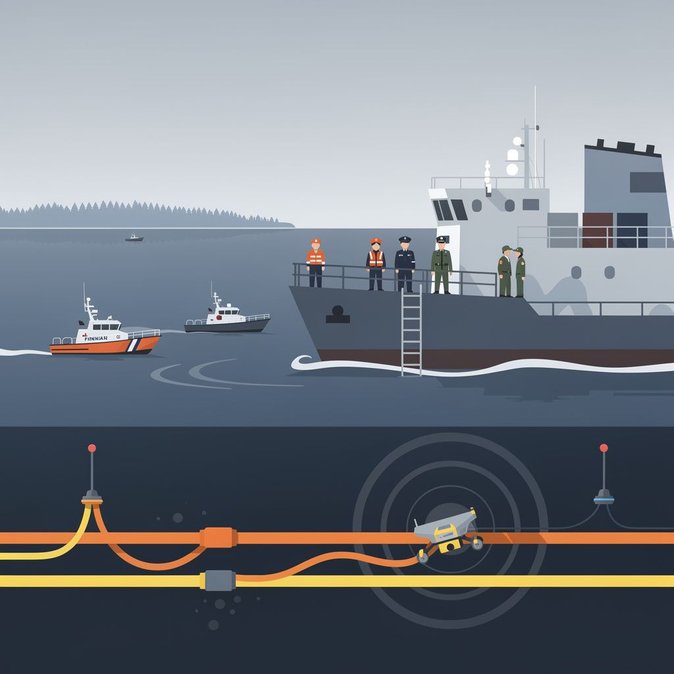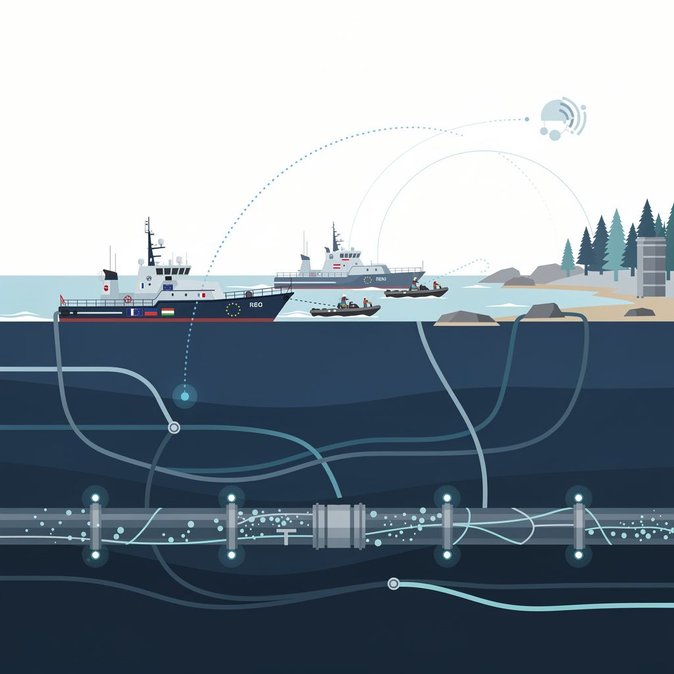
Finland is centre-stage this week as more than 600 coast-guard officers, soldiers, police and technical experts from 14 EU Member States converge on Hanko and the Gulf of Finland for MARSEC EU 26 – the Union’s flagship maritime-security exercise. Organised by the Finnish Border Guard together with Frontex, EMSA and the European External Action Service, the drill moves the annual MARSEC series for the first time into the shallow, cable-dense waters of the Baltic Sea. The three-phase exercise began with a table-top simulation that tested how quickly coastal states can share intelligence when a suspicious vessel loiters above a fibre-optic cable that carries 95 % of Europe’s internet traffic. It then progressed to two live “LIVEX” scenarios: in the first, command centres in Helsinki, Stockholm and Tallinn practised fusing AIS data, satellite imagery and coast-guard radar into a single maritime picture; in the second, Finnish special-operations teams fast-roped from helicopters onto the ice-breaker Polaris, searching compartments and neutralising mock explosive devices planted near a subsea power line. Beyond tactics, MARSEC EU 26 serves a strategic purpose. The EU updated its Maritime Security Strategy in 2023 after unexplained damage to the Nord Stream pipelines and subsea telecom cables. The Baltic – crowded, shallow and bordering Russia – is viewed as a prime target for hybrid threats. By hosting the exercise, Finland signals that its 2023 NATO accession has not dimmed its EU responsibilities; rather, Helsinki is positioning itself as a regional hub for the new Integrated Surveillance Mechanism (ISM) for cable security that Brussels wants operational by 2027. For global-mobility managers, the drill is more than a military show-piece. Any real disruption to Baltic subsea infrastructure would instantly affect international data flows, aviation navigation, and the energy grid that powers Helsinki Airport and the Port of Hamina-Kotka. MARSEC EU 26 therefore doubles as a business-continuity rehearsal: shipping lines such as Finnlines supplied vessels, and telecom operators practised rerouting traffic through Sweden in the event of a cut. Companies with staff assignments in Finland should review their own contingency plans in light of the scenarios rehearsed this week. The exercise concludes this evening with an after-action review in Turku; preliminary lessons point to the value of common boarding procedures and rapid drone detection. Final recommendations will feed into both EU legislation on cable security and Finland’s forthcoming amendments to the Border Guard Act, expected to reach Parliament later this autumn.
Source: European External Action Service