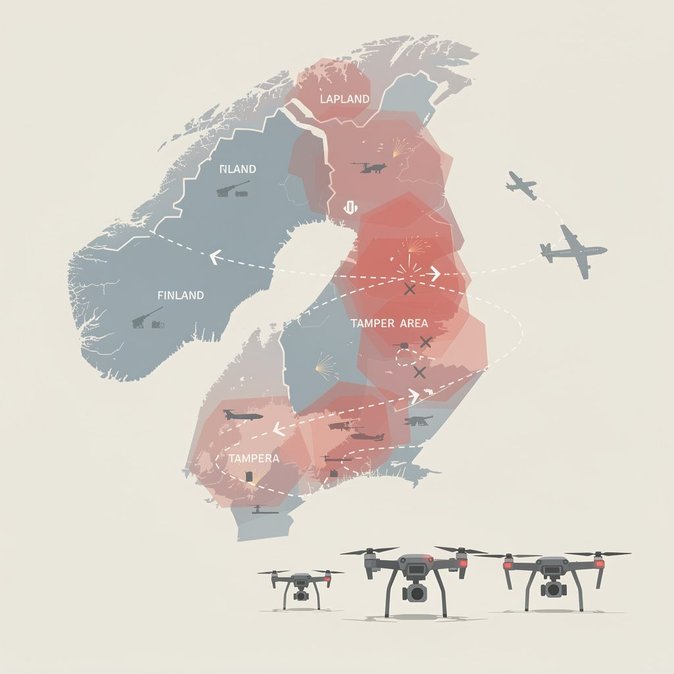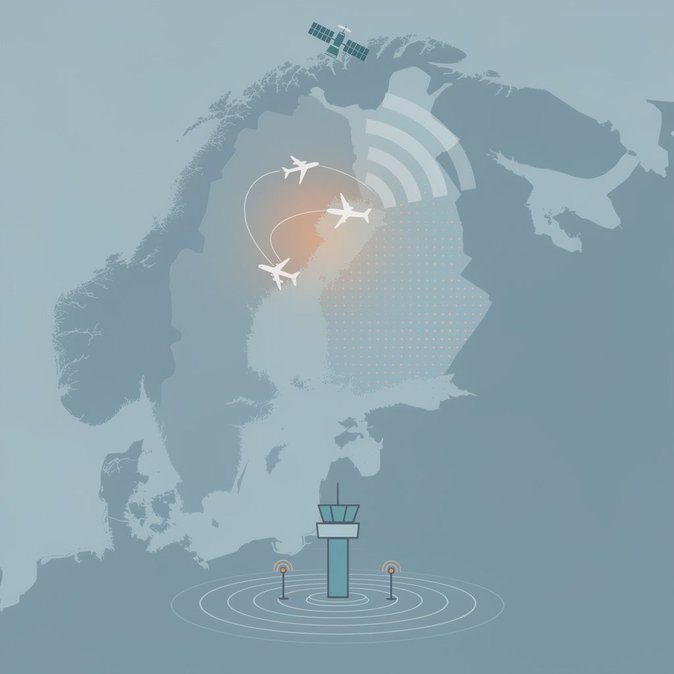
For nearly three weeks, a pocket of intense Global Navigation Satellite System (GNSS) interference has sat over Finland’s lake district, but the situation spiked on 18 September when 100 % of aircraft flying through the 61° N 26–27° E corridor broadcast degraded-navigation alerts, according to independent aviation risk monitor FlySafe. The high-jamming zone has crept inland from the Gulf of Finland and now straddles some of the domestic and regional flight paths that link Helsinki-Vantaa with eastern Finland and Russia’s border region. FlySafe’s crowdsourced ADS-B analysis shows that while the Finland Flight Information Region (FIR) averaged only 6.5 % degraded signals on 18 September, the localised inland cell was at saturation. Helsinki-Vantaa handled 507 movements on Thursday, well within its normal range, confirming that flight operations continue thanks to inertial and ground-based backups. Nevertheless, dispatchers are being advised to brief crews on potential satellite-navigation drop-outs, re-check alternate airports, and ensure required-navigation-performance (RNP) minima can be met without GNSS. Finland’s Transport and Communications Agency (Traficom) has recorded more than 180 GNSS disturbance reports so far this year, most of them in the south-east. The Border Guard has not attributed the jamming to any specific actor, but defence analysts note that similar activity was observed on the Russian side of the frontier during recent military exercises. Under EU Aviation Safety Agency (EASA) SIB 2022-02, carriers are expected to report serious GNSS loss events and to verify that flight management systems revert gracefully to inertial reference or DME/DME updating. For corporate mobility managers, the incident is a reminder that technology-driven border initiatives such as the Schengen Entry/Exit System (EES) rely on precise time-stamped location data. Persistent interference could lengthen eGate processing times or force a temporary switch to manual stamping at land and air borders. Travellers heading to meetings in Lappeenranta, Mikkeli or Kuopio may also experience en-route re-routing, adding minutes to flights and possible knock-on delays to tight connections. Practical tips: • Check with airlines on the morning of travel whether flights are subject to revised routings. • Allow extra transfer time at Helsinki-Vantaa if you are connecting to eastern Finland. • Keep paper or offline copies of digital boarding passes and hotel bookings in case mobile data coverage is impaired by wider spectrum interference.
Source: FlySafe