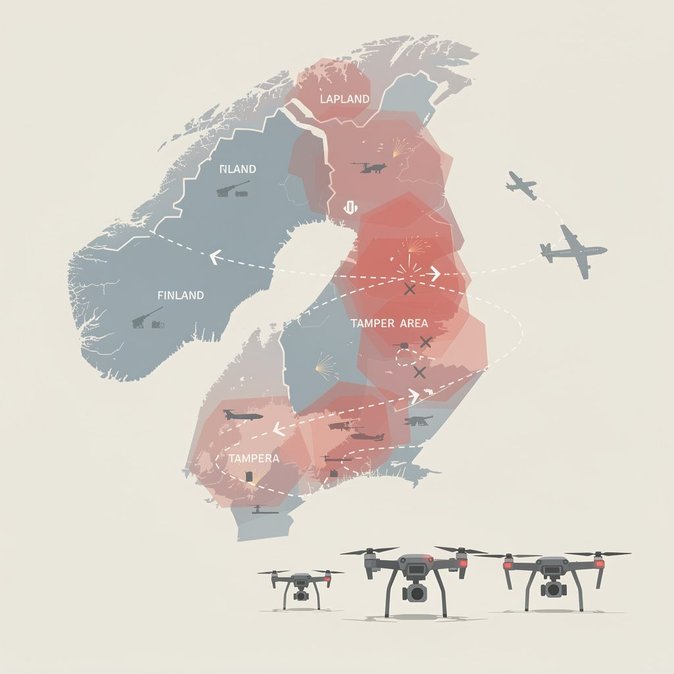
Finland’s Aeronautical Information Service (AIS) issued an unusually dense pre-flight bulletin for 18 September, activating more than a dozen Temporary Danger Areas (TDAs) across the Helsinki FIR. The restrictions, published at 04:30 UTC, cover military live-fire zones, beyond-visual-line-of-sight (BVLOS) drone test corridors and low-level flare exercises stretching from Sodankylä in Lapland down to Tampere. Among the most consequential for business aviation is TDA EFD989 over Tampere-Lielahti, active daily 06:00–18:30 local time until 20 September. The area sits directly beneath the busy descent profile into Tampere-Pirkkala, forcing arriving jets above 3 500 ft AMSL to accept longer track-miles or holding delays. Further north, EFR92 B/C at Rovajärvi extends up to FL130 and will disrupt typical step-climb profiles for Helsinki–Rovaniemi flights until 18:00 local. Unmanned-aviation operators are also affected. A newly established UAV danger area (EFD1095) near Sodankylä is active 24/7 through 26 September, with a 15-km radius up to 150 m AGL reserved for Arctic-weather drone trials. AIS warns of possible GPS-jamming tests in the same sector. The Finnish Border Guard confirms that the surge in airspace reservations is linked to a series of joint Nordic defence drills and civil-security rehearsals ahead of the large-scale ‘Arctic Shield 26’ exercise that peaks in October. Civil operators filing flight plans through Eurocontrol are receiving automatic routing suggestions, but pilots using Visual Flight Rules must consult the full NOTAM text and carry alternate-route charts. For corporate flight departments the operational takeaway is to check replanned fuel loads, verify Special Use Airspace closures en route and brief crews on potential radio-congestion hotspots. Operators of aerial-work drones should defer flights in the affected municipalities or coordinate via Fintraffic’s U-Space portal.
Source: AIS Finland Pre-Flight Bulletin