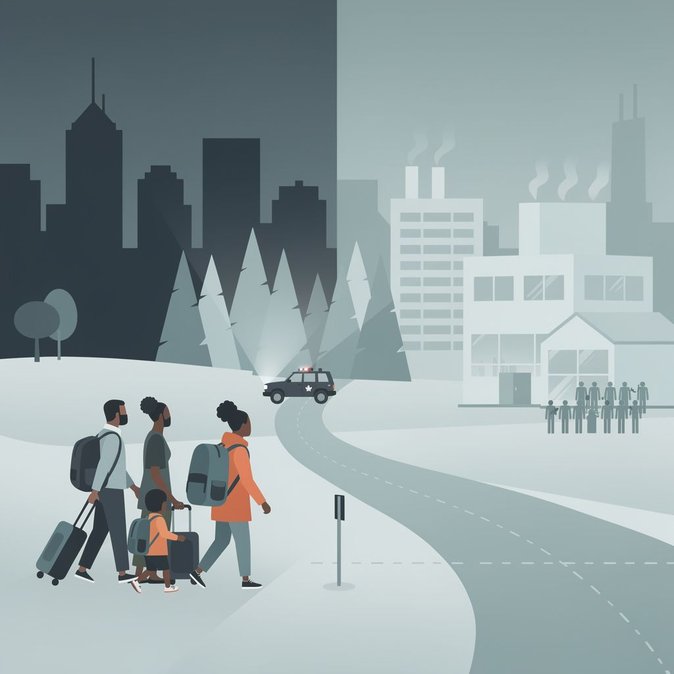
A sweeping U.S. Supreme Court ruling in June upheld President Donald Trump’s decision to cancel Temporary Protected Status (TPS) for roughly 300,000 Haitians. The move instantly thrust thousands of people who had been living and working legally in the United States into irregular status – and pushed a growing number to try their luck across the northern frontier. Over the past month, advocacy groups in Montreal say daily calls from Haitians looking for advice on how to reach Canada have quadrupled. Canada’s border with the United States is the longest in the world and, until recently, one of the most porous. Public backlash over irregular crossings at Quebec’s Roxham Road prompted Ottawa to shut the unofficial entry point in 2023 and to amend the Safe Third Country Agreement so that anyone intercepted within 14 days of crossing can be summarily returned to the United States. The tougher rules have driven smugglers to carve new forest paths and charge migrants up to US$700 for a nighttime trek across what the RCMP call “the Slash.” Once inside Canada, Haitians face a paradox. Deportations to Haiti are considered too dangerous, so claimants who can remain hidden for two weeks become eligible for a work permit and a slow-moving asylum process. That limbo is still preferable, many say, to the immediate risk of arrest and removal they now face in the United States. Community organisations such as the Haitian Support Center in North Montreal are overwhelmed, fielding dozens of requests a day for housing, legal aid and help enrolling children in school. Canadian officials are watching nervously. Haitians already make up the single-largest nationality of asylum seekers, and the Carney government has been keen to show it can enforce its border while maintaining humanitarian credentials. Ottawa has quietly increased joint patrols with U.S. Customs and Border Protection, and RCMP officers now rely on drones, motion-sensing cameras and all-terrain vehicles to police remote crossing points. Critics argue the clamp-down simply increases the cost – and danger – of crossing without stemming the flow. For Canadian employers struggling with acute labour shortages, the influx is a double-edged sword. The Safe Third Country changes mean most newly arrived Haitians will wait months, sometimes years, before receiving open work permits, prolonging the time they rely on social assistance. Immigration lawyers warn that if Ottawa does not create a targeted humanitarian or economic pathway, it risks recreating the very backlog that has bedevilled the refugee system since 2017.
Source: The Atlantic