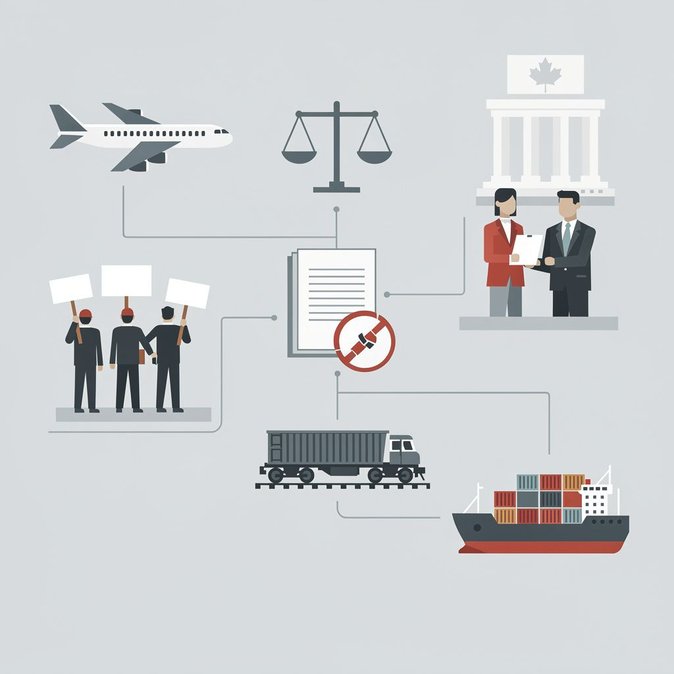
As Parliament returns for its fall sitting, the Liberal government is poised to table amendments to Section 107 of the Canada Labour Code that would give federal mediators broader powers to impose binding arbitration in strikes or lock-outs affecting essential services such as airlines, ports and rail. Government House Leader Steven MacKinnon said the goal is to resolve disputes “before the travelling public and exporters feel the pain,” pointing to last summer’s week-long Air Canada cabin-crew strike that stranded thousands of passengers. Under the forthcoming bill—expected to be folded into a larger “Building Canada Strong Act”—federal cabinet would be able to trigger a 72-hour cooling-off period during which a special mediator could deliver a public report on the state of bargaining. If the parties still cannot reach a deal, the Canadian Industrial Relations Board could order binding arbitration without waiting for a House or Senate vote. Business travel associations welcomed the proposal, arguing that repeated work stoppages at airports and marine terminals have undermined confidence in Canada’s supply chains. “Global companies need predictability. Losing a week of belly-cargo capacity on Toronto-London routes costs millions,” said the Canadian Global Mobility Council in a briefing note to MPs. Unions, however, warn that pre-emptive arbitration would undercut the right to strike. The Canadian Labour Congress said that any new limits must come with safeguards—such as guaranteed timelines for arbitrators and transparent criteria defining when a disruption is of “national interest.” If passed, the reforms could come into force as early as spring 2027, in time for the peak travel season and for infrastructure upgrades tied to the 2026 FIFA World Cup. Employers in federally regulated sectors are already reviewing contingency plans and collective-agreement language to prepare for the new dispute-resolution regime.
Source: Global News