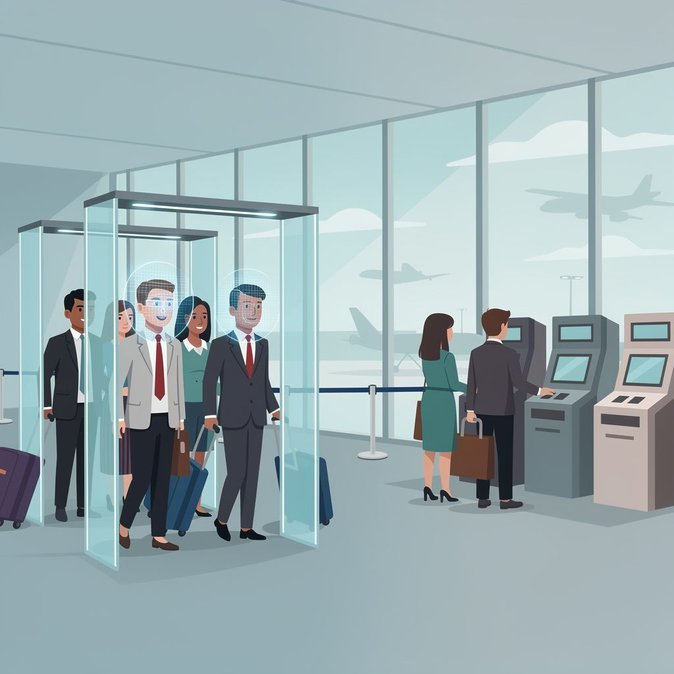
U.S. frequent international travelers received a glimpse of the future of border processing today as Customs and Border Protection (CBP) confirmed that Global Entry members can now complete admissions without stopping at a kiosk in six airports: San Francisco (SFO), Boston Logan (BOS), Dallas/Fort Worth (DFW), New York JFK, Philadelphia (PHL) and Seattle-Tacoma (SEA). Instead of scanning a passport and fingerprints, enrolled passengers simply walk through a designated lane where high-resolution cameras capture their image on the move and match it against CBP’s biometric database. If the facial comparison confirms identity, the traveler’s information appears on a CBP officer’s tablet and the individual is waved through for the standard verbal customs questions—no paper receipt, no touch screen and, in most cases, no queuing. CBP says the so-called “kiosk-free” flow cuts per-passenger processing time from roughly 30 seconds at the machine to under 6 seconds, freeing floor space in congested arrival halls and improving the overall passenger experience. The pilot is part of the agency’s congressionally mandated Biometric Entry-Exit program, which now covers more than 30 U.S. airports for departing flights and is steadily expanding on arrival. Airport authorities welcome the change; San Francisco International projects a 15 percent increase in peak-hour throughput, potentially allowing airlines to schedule additional wide-body service without expanding facilities. Business-travel managers say faster clearance can help protect tight connection windows and reduce missed-meeting risk for executives shuttling between U.S. hubs. Privacy advocates continue to press CBP for stronger opt-out signage and shorter data-retention windows, but Global Entry users already consent to facial recognition as part of enrolment and can request manual processing if they prefer. CBP insists the algorithm’s false-match rate is under 0.5 percent and that images of U.S. citizens are deleted within 12 hours. If performance data remain positive, CBP plans to retrofit additional Global Entry airports over the next 18 months and has hinted that a “walk-through” model could become standard for all U.S. permanent-resident card holders in 2027. Companies should update travel policies to remind employees that Global Entry enrollment will deliver even bigger time savings on trips that end at the six pilot airports—and to ensure staff understand how to opt out if they have privacy concerns.
Source: Kiosk Marketplace