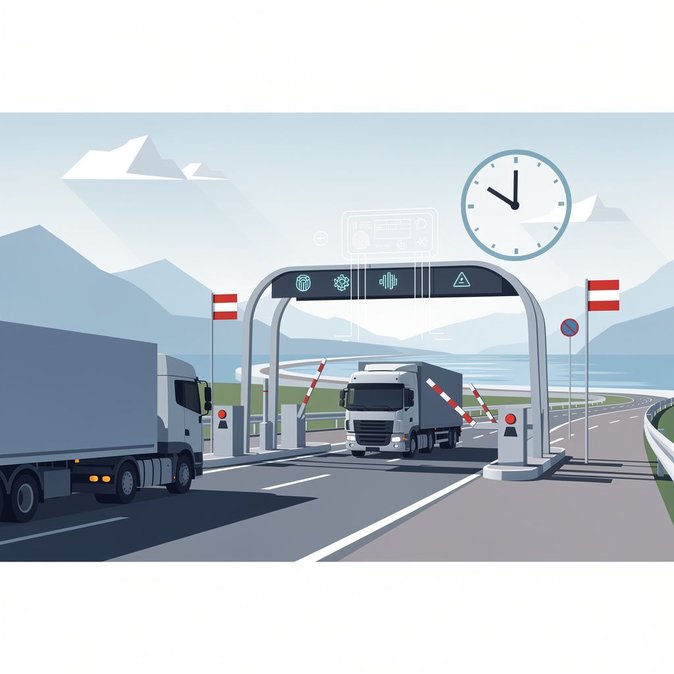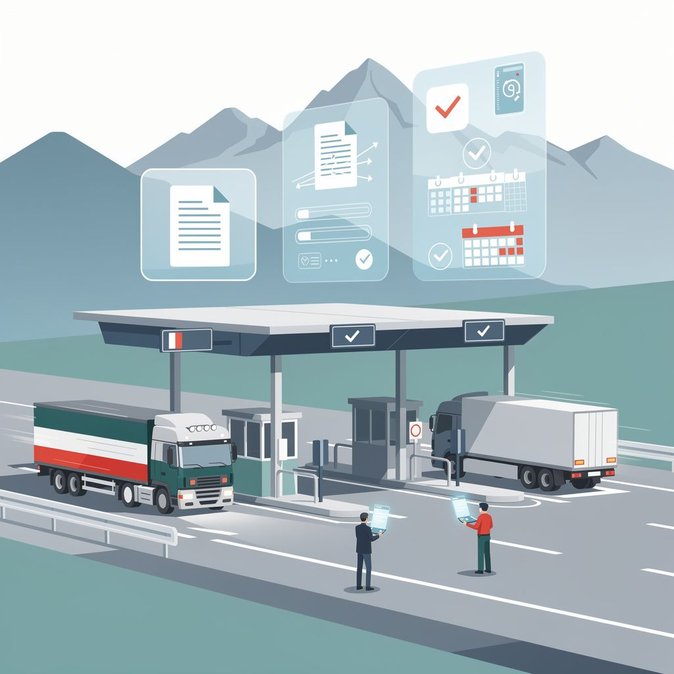
Austria’s ambitious Smart Border Austria programme – the end-to-end digitalisation of all customs and goods-control procedures at land frontiers – passed a major milestone today, 22 September 2026, when the Hohenems border office in Vorarlberg switched to the new “Border-Crossing Light” process for outbound traffic to Switzerland and Liechtenstein. Hohenems is the last of six western corridor posts (Tisis, Höchst, Mäder, Meiningen, Lustenau and Hohenems) to go live; its activation completes the pilot phase that has been running in Vorarlberg since late June. The roll-out replaces the long-standing paper-based “Laufzettel” transit-slip system, which will cease entirely on 15 September 2026. Under the new model, carriers submit pre-arrival messages (IEATBT44) through Austria’s e-Zoll platform before crossing the border. Automated number-plate and consignment recognition at the lane then validates the declaration in real time, allowing trucks that meet risk-profiling criteria to cross without stopping. Where an inspection is required, the driver is automatically routed to a designated control bay and alerted via the Smart Border mobile interface. According to the Ministry of Finance (BMF), average clearance times at pilot crossings have fallen from 12 minutes to under four, cutting queues on the A13 motorway by up to 60 %. For exporters, importers and logistics providers the change is more than a tech upgrade; it is a regulatory mandate. After 15 September all goods movements through western land borders must be filed electronically, even for empty returns. Companies that have not yet integrated their transport-management systems with the BMF API risk fines and delays. The Austrian Freight Forwarders’ Association (ZV) is urging members to run dry-run submissions this week and to train drivers in the new QR-code workflow, noting that incorrect messaging accounted for 18 % of holds during the first two pilot weeks. The government positions Smart Border Austria as part of a broader EU customs-ecosystem shift that includes the Entry/Exit-System (EES) for travellers and the Import Control System 2 (ICS2) for air cargo. Full nationwide deployment – covering all land, rail and Danube river crossings – is scheduled for 1 December 2026, at which point Austria will be one of the first EU member states to offer 100 % paperless border formalities. Neighbouring Switzerland and Liechtenstein have signalled that they will recognise Smart Border reference numbers as proof of Union status, smoothing two-way flows for just-in-time industries in the Bodensee-Alpenrhein economic zone. From a mobility perspective, the removal of manual stamping also benefits business travellers who routinely accompany high-value or sensitive cargo. Drivers and company representatives will no longer need to leave the vehicle to obtain physical endorsements, reducing both processing time and personal security risks at congested checkpoints. The BMF says a multilingual help-desk and a simplified “tourist-mode” for occasional users will be added before the winter peak, when cross-border courier volumes for e-commerce typically surge by 30 %.