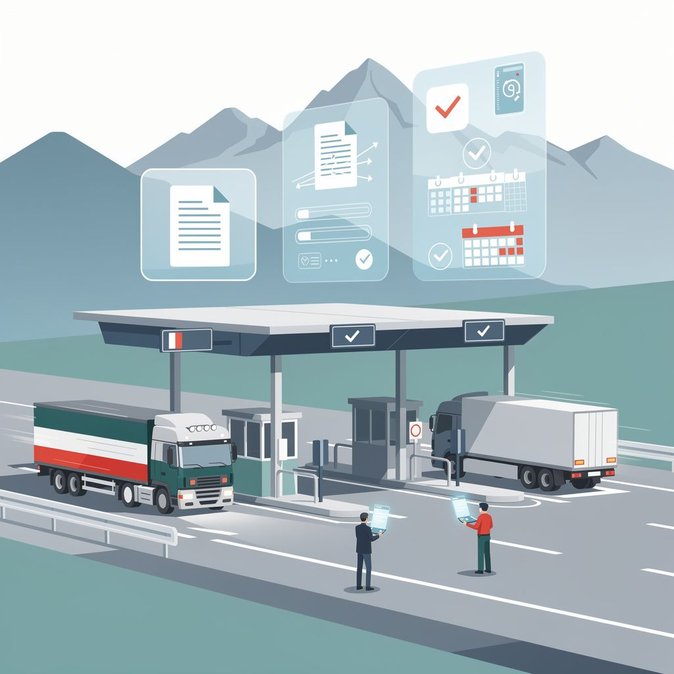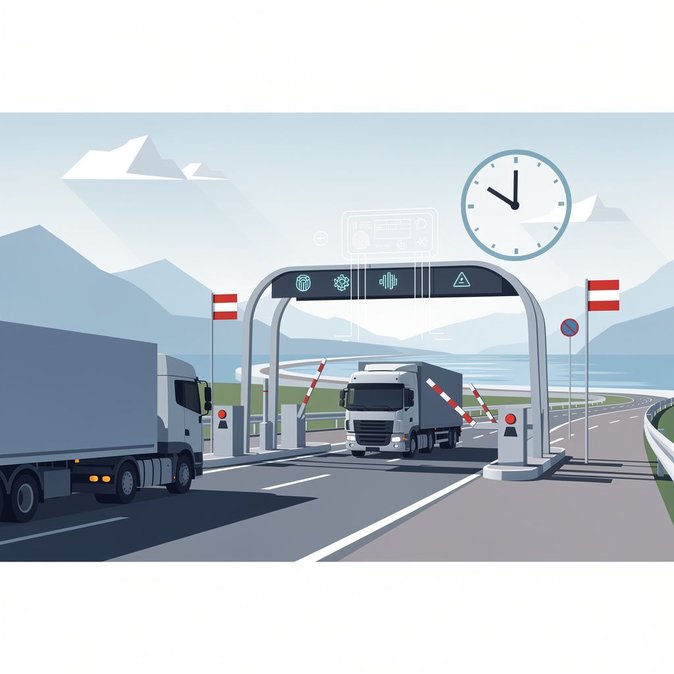
Austria has reached a new milestone in its multi-year Smart Border Austria programme: from 22 September 2026 the border customs office of Hohenems on the Swiss frontier has become the first site to operate a fully automated “Rolling Corridor – Exit”. The system uses licence-plate recognition, GPS beacons and pre-lodged electronic transit messages (IEATBT44) to clear outbound trucks in real time, eliminating the need to stop at the customs booth. A separate sensor array confirms that the vehicle has physically crossed the border, after which the consignment is automatically released in Austria’s customs IT system. The launch is the final pilot in a project that has been gradually digitising Austria’s western road freight crossings since mid-2024. Traditional paper “Laufzettel” routing slips were phased out on 15 September, and five Vorarlberg crossings (Tisis, Höchst, Mäder, Meiningen and Lustenau) have already switched to paper-free processing. At Hohenems, the new technology is initially limited to outgoing traffic, but an inbound module is scheduled for December when Smart Border Austria moves into nationwide production mode. From 1 December, all commercial carriers will be obliged to submit pre-arrival messages, with penalties for non-compliance. For logistics companies the change promises faster transit times and lower administrative costs. A test week in August showed an average reduction of 12 minutes per truck compared with manual stamping. Customs brokers report that they can now process multiple consignments simultaneously, freeing staff for higher-value compliance work. However, carriers must adapt their IT: trucks must be equipped with on-board units capable of sending the IEATBT44 message before arriving at the border; failure to do so triggers an automatic diversion to the manual lane. The Ministry of Finance stresses that data protection remains a priority. Vehicle identifiers are stored only for as long as legally required, and the system is air-gapped from other law-enforcement databases unless a risk flag is generated. Switzerland’s Federal Customs Administration, which operates compatible technology at Diepoldsau on the opposite side, has confirmed bilateral recognition, meaning trucks enjoy a true “drive-through” experience. For multinational companies that route high-value or time-sensitive shipments through Austria, the automated corridor could become a competitive differentiator. Freight forwarders are already advertising “paperless Vorarlberg routings” to clients in southern Germany and northern Italy, and industry associations expect similar roll-outs on the Brenner and Tarvisio corridors in 2027.