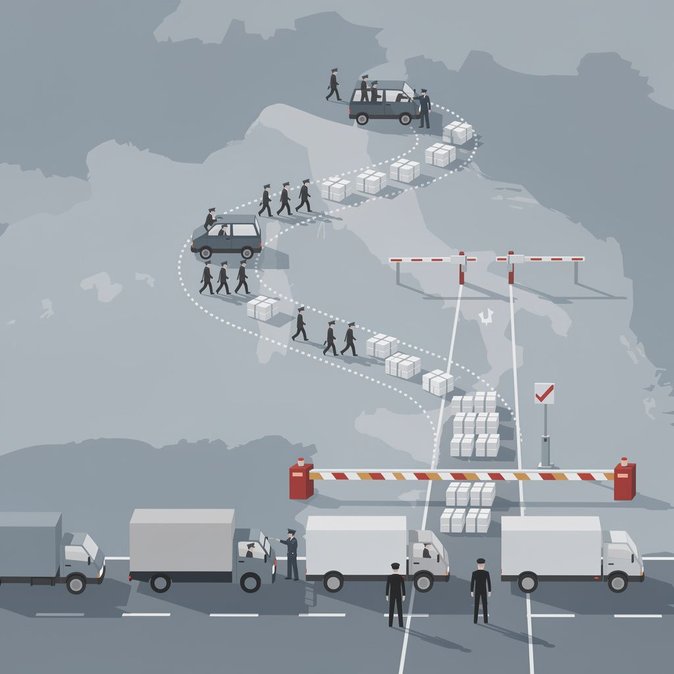
In a pre-dawn sweep on 22 September, Carabinieri units operating under the Trento provincial command executed arrest warrants against 20 suspects accused of running three inter-linked criminal organisations that specialised in two highly lucrative trades: large-scale cocaine shipments from South America and the clandestine movement of migrants along the so-called Balkan route. According to details released by investigators, the groups used the same logistical channels to move both people and drugs. Migrants—mostly of Middle-Eastern origin—were collected in Serbia and Bosnia, guided across the Slovenian and Croatian borders and then hidden in vans with false floors bound for northern Italian regions such as Trentino-Alto Adige and Veneto. The proceeds financed multi-kilogram cocaine imports that entered Europe through Adriatic ports before being broken down for distribution in the Italian domestic market. The 18-month investigation, code-named “Aquila Nera,” relied on wire-taps, drone surveillance of mountain passes and collaboration with Slovenian and Croatian police. Prosecutors say the ring charged up to €4 000 per migrant and moved at least 300 people in the first half of 2026 alone. They estimate wholesale drug revenues in excess of €10 million. Beyond the criminal aspect, the case highlights how irregular migration flows are increasingly exploited by poly-crime networks that view humans and narcotics as interchangeable profit centres. For policy-makers the operation is a reminder that border-control cooperation with neighbouring EU states remains indispensable even inside Schengen—particularly as Italy prepares to discuss alternative security measures with Slovenia and Croatia at today’s ministerial meeting in Pordenone. Companies that post staff to northern Italy or the Alpine region should expect tightened roadside spot-checks this week while evidence is gathered and vehicles linked to the investigation are traced.
Source: Rai News TGR Sicilia