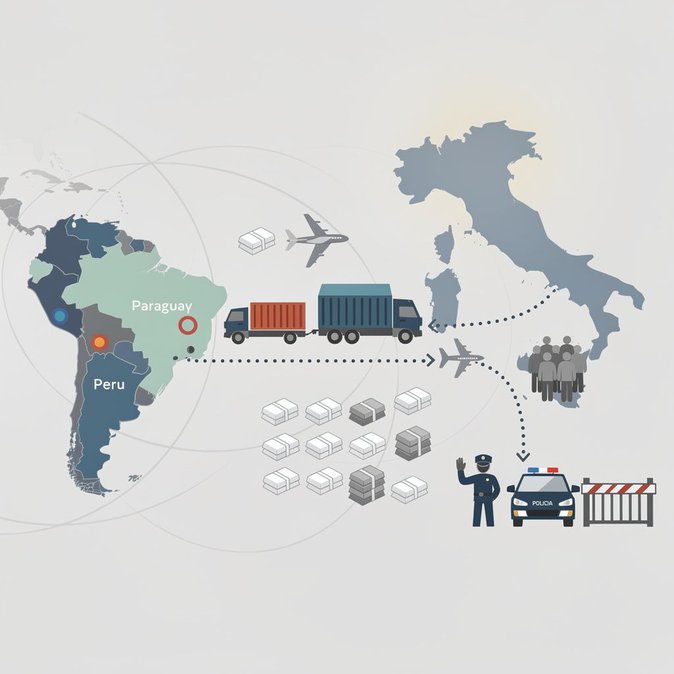
Italian law-enforcement agencies struck a major blow against trans-national crime – and a secondary route for irregular migration – with today’s "Operazione Aquila Nera" (Black Eagle). At dawn on 22 September the Carabinieri of Trento, supported by anti-mafia prosecutors and police forces in nine Italian provinces, executed 20 arrest warrants that simultaneously hit cells in Italy, Paraguay and Peru. Investigators say the three interconnected gangs, run largely by South American nationals, moved at least 82 kg of high-grade cocaine towards the Italian market and, for extra profit, hid undocumented migrants in rented trucks they drove from Slovakia through Hungary and Austria. According to the indictment, each migrant paid about €700 for the final leg into Italy; once inside Schengen they were dispersed to informal labour markets in agriculture and construction. In one 2023 incident two defendants allegedly ferried 15 Syrian nationals while also carrying narcotics, illustrating the business model that mixes people-smuggling with drug logistics. Police intercepted phone calls in Spanish and Quechua and seized encrypted phones that continued to relay orders even while the ringleader was in prison. The operation is the latest example of Italy’s strategy of coupling anti-drug and anti-migration intelligence, after the Interior Ministry created joint task forces with Europol earlier this year. The raids involved border-police units specialising in document fraud, highlighting how traditional organised-crime investigations increasingly overlap with migration control. For international employers, the case is a reminder that Italy’s northern road corridors remain under heightened scrutiny. Companies moving cargo or assigning drivers across the Brenner and Tarvisio routes can expect random inspections and delays this autumn as authorities follow up on evidence seized today. Mobility and security managers should review driver vetting, chain-of-custody procedures and subcontractor compliance to avoid unwitting involvement in trafficking networks.
Source: ANSA