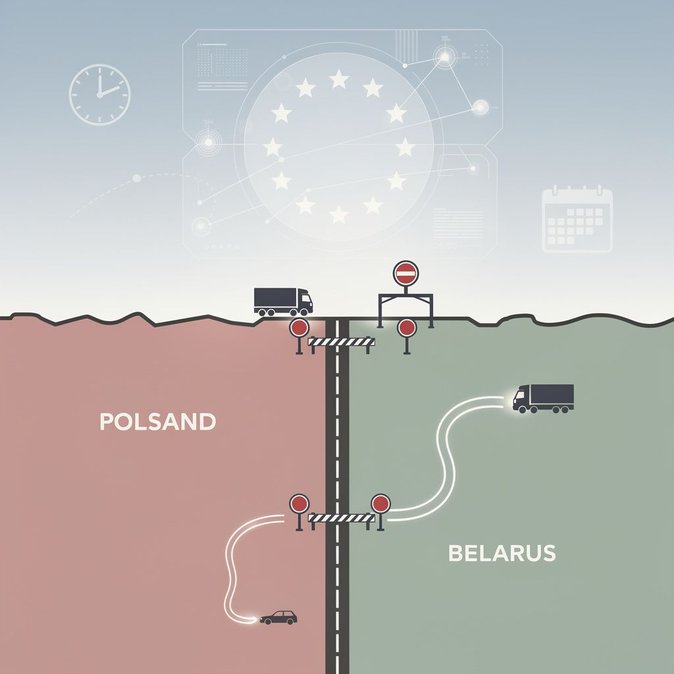
The Polish Border Guard announced on 24 September 2026 that border traffic at the Połowce and Sławatycze road crossings on the Belarusian frontier has been “temporarily suspended.” According to the Guard’s live border-traffic portal, the shutdown is part of work to integrate the final two land posts into the EU-wide Entry/Exit System (EES), which records the biometric data and travel history of every third-country national entering or leaving the Schengen Area. Although the two posts handle only a fraction of overall passenger volume, they are vital for local residents and for niche freight routes that avoid the heavily congested Koroszczyn–Kozłowiczi corridor. The upgrade involves installing e-gates, biometric kiosks and high-speed data links that connect directly to the EU’s central EES hub in Strasbourg. Officers have also received new handheld scanners able to read ICAO-compliant e-passports even in sub-zero winter conditions. For logistics companies, the abrupt closure means a detour of at least 120 kilometres via Terespol or Kuźnica. Forwarders shipping perishable goods should build extra transit time into delivery schedules; temperature-controlled cargo cannot linger in holding areas because power supplies there are limited. Business travellers who planned to use the crossings for day trips into Belarus will have to reroute until the posts reopen, which the Border Guard tentatively expects to happen “within two weeks” after acceptance testing is complete. The suspension illustrates how Poland is sprinting to meet the EU’s 2027 deadline for full EES deployment. Warsaw was once criticised for lagging behind larger Schengen states, but the Interior Ministry now claims to have 71 of 73 border points fully operational. Companies moving staff into or out of Poland should therefore expect more frequent biometric scans and must ensure that employees’ passports have an embedded chip in good working order, or risk secondary inspection delays.