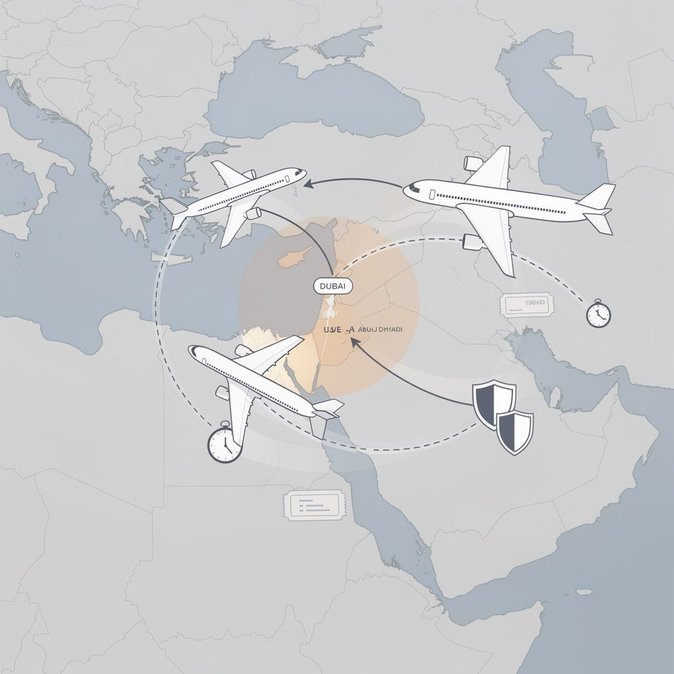
The US Overseas Security Advisory Council (OSAC) published a security alert late on 9 October warning travellers to prepare for sudden air-space closures, flight delays and cancellations across the Middle East, including the United Arab Emirates. The advisory follows a week of drone and missile attacks on airports in Saudi Arabia and Yemen that have already forced Etihad, KLM, Singapore Airlines and Cathay Pacific to extend route suspensions into late October. Conflict-zone bulletins released by the European Union Aviation Safety Agency on 4 October also urge carriers to avoid Persian Gulf waters and reroute over inland Saudi corridors, adding up to 90 minutes to Europe-to-Asia block times. Dubai International (DXB) and Abu Dhabi (AUH) remain operational, but OSAC warns closures could occur “with little or no notice”. Business-travel managers have been advised to keep traveller tracking data current, establish alternate routings via Muscat or Doha, and brief employees on emergency shelter procedures. Companies rotating staff through Abu Dhabi Global Market or Dubai International Financial Centre must budget for higher ticket prices as capacity tightens; airfares to London and Singapore have already risen 8 per cent week-on-week, according to GDS data. Insurers have upgraded the UAE’s air-war-risk rating from ‘medium’ to ‘heightened’. Underwriters now require 48-hour advance notice before quoting war-risk cover for charter operations using UAE airspace, potentially affecting corporate shuttles to oil and gas installations. The UAE General Civil Aviation Authority says it is working with international partners on contingency corridors that would keep freight flows moving even if FIR closures extend north of 25°N. Travellers transiting UAE hubs should monitor airline channels and sign up for airport-push notifications. OSAC notes that travellers caught by last-minute cancellations can claim hotel and meal vouchers under UAE consumer-protection regulations, but only if they have checked in online or at the airport.
Source: UECN