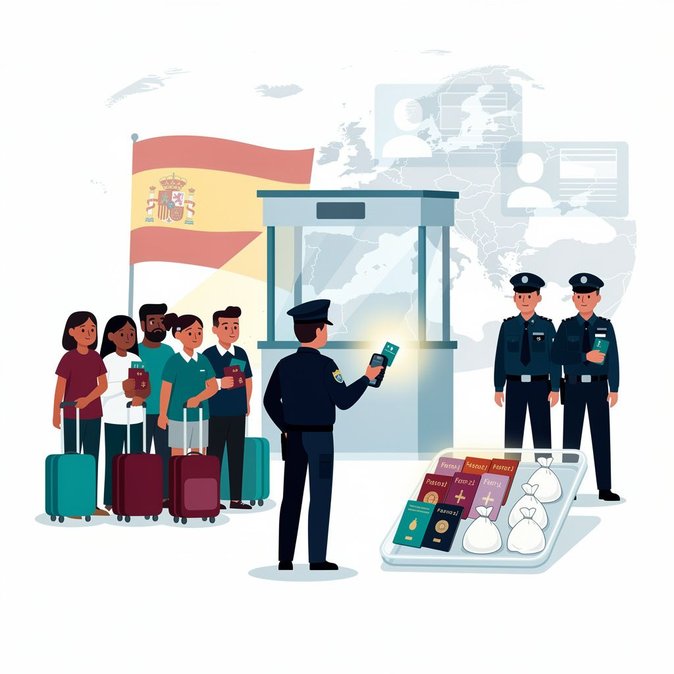
Spain’s National Police announced on 14 October that they have broken up a criminal network operating from Sabadell (Barcelona) that specialised in moving Dominican nationals into the Schengen Area by providing them with counterfeit or fraudulently obtained Colombian passports. Four key suspects—including the alleged ringleader—were arrested after simultaneous raids in the Barcelona suburb. The organisation exploited legal loopholes in Latin America: recruits first travelled from the Dominican Republic to Colombia or Peru, where local accomplices helped them obtain genuine Colombian identity cards through false witness statements. With those IDs they secured authentic Colombian passports, which allow visa-free entry to most of the EU. From South America, migrants typically flew to Paris and other French gateways before dispersing across Europe. Police say the gang charged up to €10,000 per migrant and laundered proceeds through cash-intensive businesses in Catalonia. During the raids officers seized 3.7 kg of cocaine and €8,700 in cash, highlighting the intersection between people-smuggling and narcotics trafficking. The investigation began in late 2025 after border officials noticed a pattern of Dominican nationals presenting Colombian documents at Spanish airports. For global-mobility and assignment teams, the bust is a reminder that highly sophisticated document fraud continues despite digitalisation of border processes. Companies sponsoring Latin American talent for Spanish roles should ensure candidates’ civil documents are thoroughly apostilled and verified. The case may also prompt Schengen states to review risk profiles for Colombian passports, potentially leading to more secondary inspections and longer queues for legitimate travellers. The Interior Ministry praised the collaboration with AMERIPOL and hinted that similar joint operations are underway in Madrid and Valencia. Prosecutors will press charges for facilitation of irregular migration, document forgery, money-laundering and drug offences; the suspects face up to 12 years in prison if convicted.
Source: Ministerio del Interior