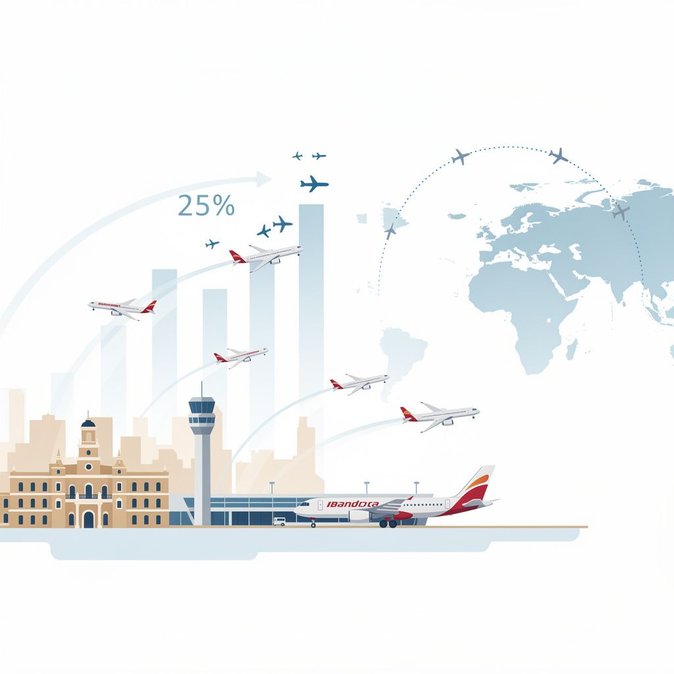
Speaking at Madrid’s Foro CREO on 15 October, Iberia’s Chief Commercial & Network Officer María Jesús López Solás said the flag-carrier intends to boost its fleet from 120 to 150 aircraft and open new routes to North and Latin America once the €2.2 billion expansion of Adolfo Suárez Madrid-Barajas airport is complete. The works will raise the hub’s capacity from 70 million to 90 million passengers a year by 2031. Demand between Europe and Latin America has been climbing at roughly 6 % annually, López Solás noted, while North-American traffic is growing 3-4 % per year. Iberia has already launched services to Orlando, Toronto and several Brazilian secondary cities under its “Flight Plan 2030”, and the executive hinted at upcoming announcements for secondary U.S. gateways and additional frequencies to Mexico. The carrier’s growth hinges on infrastructure: a new “H Zone” at Barajas is already built, but additional police staffing and automated border e-gates are required to handle surging transfer volumes. Iberia is lobbying Spain’s Interior Ministry to accelerate deployments ahead of the 2027 tourist season. For corporate travel programmes the news signals fresh non-stop options and potentially more competitive fares on trans-Atlantic lanes. Relocation teams moving talent between Spain and the Americas can expect improved connectivity and shorter journey times to provincial cities once feeder agreements with oneworld partners are finalised. Iberia also warned that high fuel prices linked to Middle-East tensions could squeeze margins, pushing the airline to pursue further cost-efficiency and ancillary revenue initiatives. Nonetheless, management described the current environment as a “historic opportunity” for Spain to consolidate its role as Europe’s main gateway to Latin America.
Source: Cinco Días