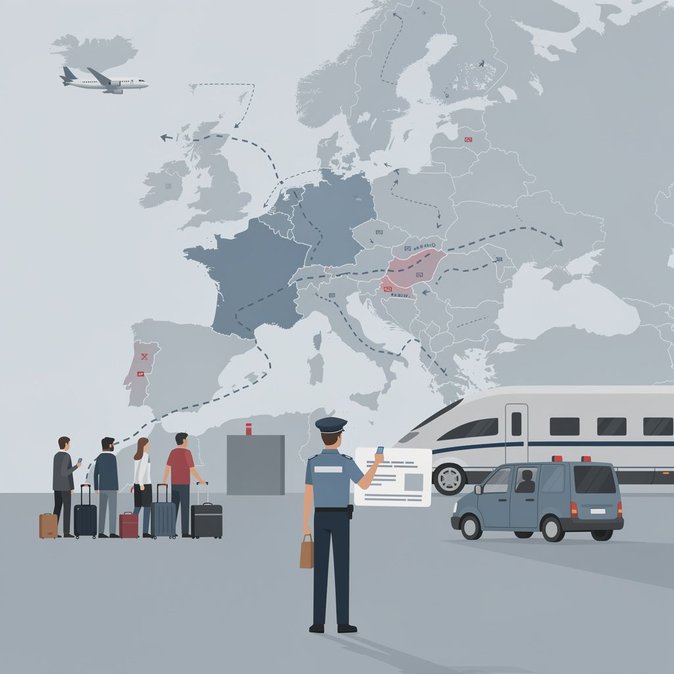
France has formally informed the European Commission that it will maintain controls at all of its internal land, air and sea borders from 1 November 2026 through 30 April 2027. The notification, published on the Commission’s Schengen ‘Temporary Reintroduction of Border Control’ dashboard on 22 October, marks the fourth consecutive half-year renewal of checks that were first re-imposed in November 2015 following the Paris terror attacks. French authorities cite “persistent jihadist threats, rising antisemitic attacks, migrant-smuggling networks and violent clashes among migrants along the Channel coast” as reasons why spot-checks remain necessary. They also point to the deteriorating global security environment—including the Russia-Ukraine war and escalating tensions in the Middle East—as well as the need to protect high-profile events such as the Paris Peace Forum (10-11 November). For companies shuttling staff between French and other EU offices, the extension means that travellers must continue to carry passports or national ID cards, and non-EU assignees must be ready to show residence permits, posted-worker A1 certificates or multi-entry Schengen visas. HR teams should review assignment schedules that involve same-day or overnight travel by road and rail, where document checks have become more frequent. Although Article 25 of the Schengen Borders Code normally caps internal controls at two years, France is applying the post-2022 reform that lets Member States prolong checks for an “exceptional additional” period where serious threats persist and proportionality is demonstrated. Paris will have to file another detailed risk assessment if it wishes to extend beyond 30 April 2027, bringing the total duration close to the new five-year ceiling. Business-travel managers should update traveller-tracking systems and alert frequent cross-border commuters that ID spot-checks could occur on any route, including TGV and Thalys trains and short-haul flights to neighbouring countries. Companies that use time-sensitive ‘just-in-time’ supply chains should also factor in potential delays at road crossings, particularly in the Pas-de-Calais region and on the Italian and Spanish borders.