The Federal Government has tabled a draft law entitled “Gesetz zur Ermöglichung der digitalen Fluggastabfertigung” that would allow passengers departing German airports to complete identity checks, boarding-pass verification and baggage drop almost entirely by smartphone or biometric kiosk. The bill, registered in the Bundestag on 15 June, amends five statutes – among them the Aviation Act, Passport Act and Residence Act – to create a legal basis for voluntary remote ID verification and encrypted data exchange between airlines, border police and airport operators.
Travelers eager to benefit from these upcoming digital processes can further simplify their journey by arranging any necessary visas, passport renewals or ETIAS authorizations through VisaHQ’s intuitive online portal. The service walks you through every requirement for Germany and beyond, submits the paperwork on your behalf and keeps you updated in real time—ensuring you’re ready for the new “Digital Fast Lanes” before you even leave home. More details are available at https://www.visahq.com/germany/
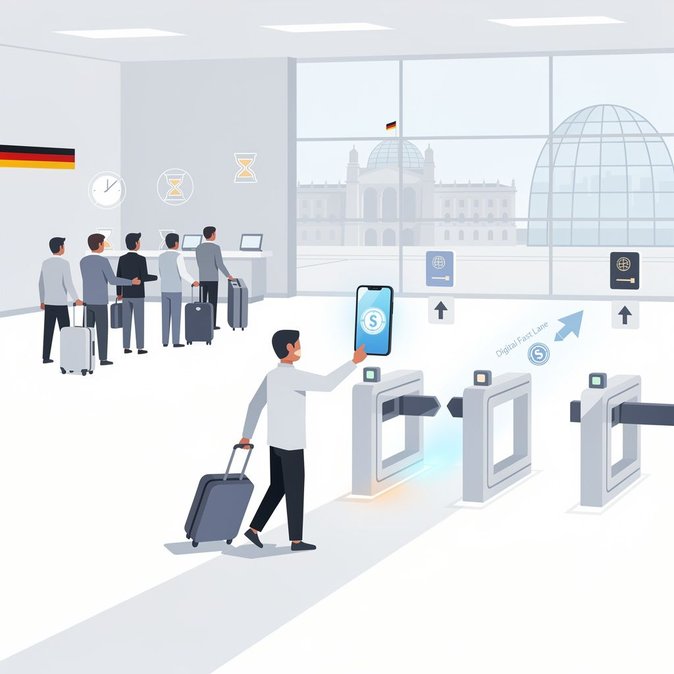
Under the proposal, travellers who opt in would scan an e-passport or electronic ID at home, link the document to their booking and receive a QR-code that serves as a single token from curb to gate. At the airport they would pass dedicated “Digital Fast Lanes” equipped with biometric cameras that match their live facial image to the encrypted token stored on their device. The government argues that the system will shorten queues, reduce staffing needs at manual counters and make it harder to use forged documents because authenticity checks occur against federal databases in real time. Participation would remain optional; anyone could still choose the traditional staffed counter. Data-protection safeguards include storage limits and the option to delete personal data immediately after departure. Airlines that adopt the scheme must offer an alternative non-digital channel to avoid discrimination against travellers without smartphones or biometric passports. For corporate travel programmes the benefits could be significant. Large employers could preload employee IDs in the company booking tool, speeding group departures and reducing dwell time at high-volume hubs such as Frankfurt and Munich. Airport operators, meanwhile, see the draft as a prerequisite for integrating the EU Entry/Exit System (EES) and the upcoming ETIAS travel authorisation into a seamless passenger journey. Industry associations have welcomed the initiative but warn that a uniform technical standard across the EU is essential; otherwise, carriers will face a patchwork of incompatible apps. The transport committee is expected to hold hearings before the summer recess, with the law slated to enter into force in early 2027 – just in time for Germany’s forecast post-EES surge in third-country arrivals.
Travelers eager to benefit from these upcoming digital processes can further simplify their journey by arranging any necessary visas, passport renewals or ETIAS authorizations through VisaHQ’s intuitive online portal. The service walks you through every requirement for Germany and beyond, submits the paperwork on your behalf and keeps you updated in real time—ensuring you’re ready for the new “Digital Fast Lanes” before you even leave home. More details are available at https://www.visahq.com/germany/
Under the proposal, travellers who opt in would scan an e-passport or electronic ID at home, link the document to their booking and receive a QR-code that serves as a single token from curb to gate. At the airport they would pass dedicated “Digital Fast Lanes” equipped with biometric cameras that match their live facial image to the encrypted token stored on their device. The government argues that the system will shorten queues, reduce staffing needs at manual counters and make it harder to use forged documents because authenticity checks occur against federal databases in real time. Participation would remain optional; anyone could still choose the traditional staffed counter. Data-protection safeguards include storage limits and the option to delete personal data immediately after departure. Airlines that adopt the scheme must offer an alternative non-digital channel to avoid discrimination against travellers without smartphones or biometric passports. For corporate travel programmes the benefits could be significant. Large employers could preload employee IDs in the company booking tool, speeding group departures and reducing dwell time at high-volume hubs such as Frankfurt and Munich. Airport operators, meanwhile, see the draft as a prerequisite for integrating the EU Entry/Exit System (EES) and the upcoming ETIAS travel authorisation into a seamless passenger journey. Industry associations have welcomed the initiative but warn that a uniform technical standard across the EU is essential; otherwise, carriers will face a patchwork of incompatible apps. The transport committee is expected to hold hearings before the summer recess, with the law slated to enter into force in early 2027 – just in time for Germany’s forecast post-EES surge in third-country arrivals.