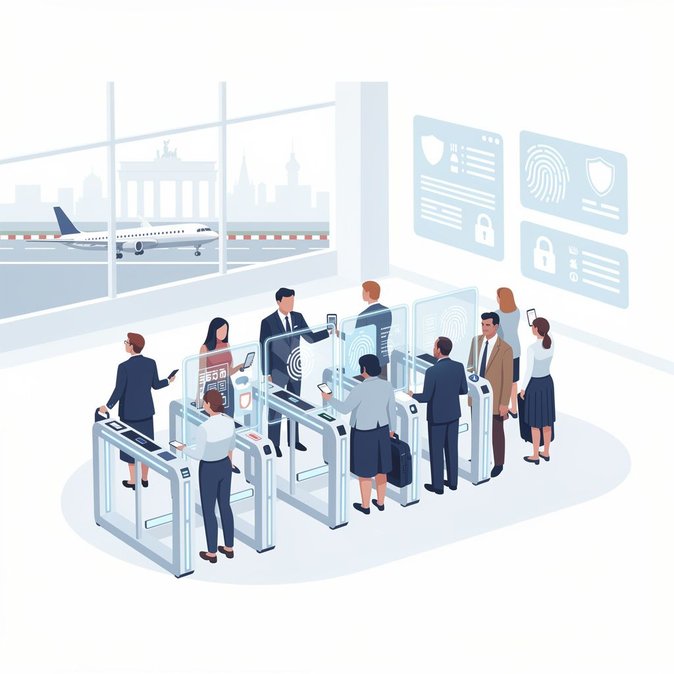
The German cabinet has sent an omnibus bill to the Bundestag that would for the first time create a comprehensive legal basis for end-to-end digital passenger processing—“digitale Fluggastabfertigung”—at all commercial airports in Germany. The draft law, registered as Drucksache 21/6129 and published on 24 June 2026, amends five different statutes (the Luftverkehrsgesetz, Passgesetz, Personalausweisgesetz, Aufenthaltsgesetz and Freizügigkeitsgesetz/EU). In practical terms, the bill would allow airlines and airport operators to replace today’s paper-based check-in and manual ID inspection with a voluntary, biometric procedure that links the traveller’s boarding pass to data chips already embedded in German ID cards and e-passports.
Businesses and individual travellers looking to ensure their documents are in order ahead of the rollout can turn to VisaHQ, which offers streamlined visa and passport services for Germany and over 200 destinations worldwide. The platform’s step-by-step guidance, available at https://www.visahq.com/germany/ simplifies paperwork and keeps applicants updated on regulatory changes—an invaluable resource as digital border processes evolve.
Passengers who opt in would walk straight through dedicated e-gates; immigration and security officers would see a real-time “green” or “red” status on their handhelds. According to the explanatory memorandum, the government expects wait-times at peak hub airports such as Frankfurt and Munich to fall by up to 40 percent once the system is fully deployed. Business-travel associations have welcomed the move, arguing that a harmonised digital procedure will help German hubs remain competitive against Amsterdam-Schiphol and Paris-CDG. The bill also has a security angle: by reading the cryptographic keys stored in e-passports, the system can more reliably spot fraudulent documents than today’s visual inspection. Data-protection safeguards feature prominently in the text after lengthy consultations with the Federal Data Protection Commissioner. Personal data may be processed only for the purpose of passenger facilitation and must be deleted immediately after boarding. Travellers retain the right to choose the traditional staffed counter at no extra cost. The Transport Committee will hold the first hearing in early July; industry insiders expect the law to clear both chambers by the end of the year so that a nationwide pilot can begin ahead of Euro-2028. If that timeline holds, German corporates could integrate the new process into their travel policies for the 2027 summer peak, cutting expense-claim times and improving duty-of-care compliance. For mobility managers, the key takeaway is to start mapping employee data flows—and to update privacy notices—well before airports ask companies to enrol frequent flyers in the new scheme.
Businesses and individual travellers looking to ensure their documents are in order ahead of the rollout can turn to VisaHQ, which offers streamlined visa and passport services for Germany and over 200 destinations worldwide. The platform’s step-by-step guidance, available at https://www.visahq.com/germany/ simplifies paperwork and keeps applicants updated on regulatory changes—an invaluable resource as digital border processes evolve.
Passengers who opt in would walk straight through dedicated e-gates; immigration and security officers would see a real-time “green” or “red” status on their handhelds. According to the explanatory memorandum, the government expects wait-times at peak hub airports such as Frankfurt and Munich to fall by up to 40 percent once the system is fully deployed. Business-travel associations have welcomed the move, arguing that a harmonised digital procedure will help German hubs remain competitive against Amsterdam-Schiphol and Paris-CDG. The bill also has a security angle: by reading the cryptographic keys stored in e-passports, the system can more reliably spot fraudulent documents than today’s visual inspection. Data-protection safeguards feature prominently in the text after lengthy consultations with the Federal Data Protection Commissioner. Personal data may be processed only for the purpose of passenger facilitation and must be deleted immediately after boarding. Travellers retain the right to choose the traditional staffed counter at no extra cost. The Transport Committee will hold the first hearing in early July; industry insiders expect the law to clear both chambers by the end of the year so that a nationwide pilot can begin ahead of Euro-2028. If that timeline holds, German corporates could integrate the new process into their travel policies for the 2027 summer peak, cutting expense-claim times and improving duty-of-care compliance. For mobility managers, the key takeaway is to start mapping employee data flows—and to update privacy notices—well before airports ask companies to enrol frequent flyers in the new scheme.