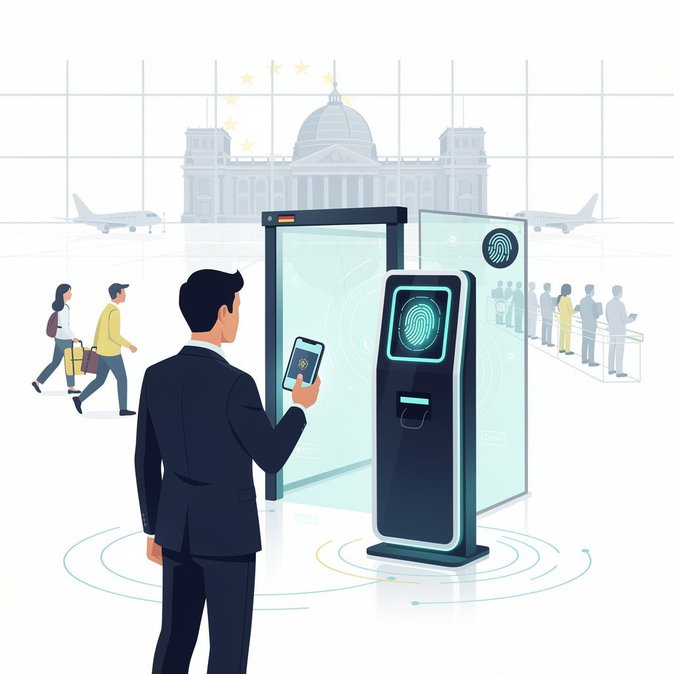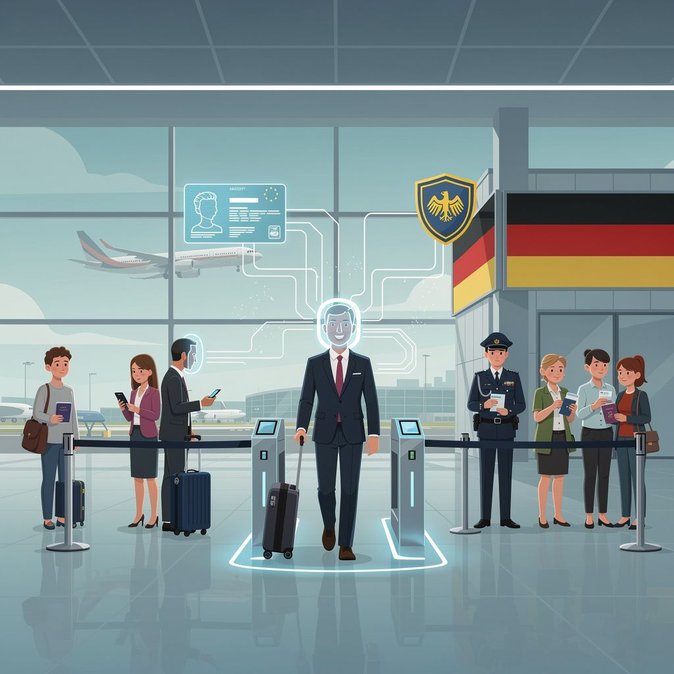
Germany’s coalition government has put speed behind its plan to take the last paper out of the airport check-in process. On 25 June 2026 the Bundestag’s transport committee tabled its final recommendation on the “Act to Enable Digital Passenger Handling”, clearing the way for a plenary vote scheduled for Friday, 26 June. The bill amends five separate statutes (the Aviation Act, Passport Act, German ID Card Act, Residence Act and the EU Free-Movement Act) so that airlines, airports and federal police can verify travellers’ identity and travel rights with a single biometric scan linked to the federal ID infrastructure. Under the draft, participation is voluntary: passengers who prefer conventional check-in may continue to present a physical passport or ID card. For those who opt in, however, a pre-travel enrolment will create a one-time digital token. At the airport that token can be read at automated bag-drop stations, security lanes and exit gates, eliminating repeated document checks. The government argues that the approach saves time, reduces queues and makes it harder to use forged documents because authenticity is checked against the federal ID database in real time. The Bundesrat’s latest written opinion backs the project in principle but wants redundancies in the data-protection chapter removed and asks Berlin to clarify its legislative competence for accepting Swiss and EEA travel documents. The Interior Ministry has promised “further precision” during the final drafting stage. If the law passes this week it could enter into force by autumn, in time for the first wave of Entry/Exit System (EES) traffic next holiday season. For corporate mobility managers the measure is more than a convenience feature. Faster front-end processing means lower minimum-connection times at hubs such as Frankfurt and Munich, giving schedulers greater itinerary flexibility. Airlines anticipate cost savings through staff redeployment while airports hope shorter dwell times will free terminal capacity just as the new Terminal 3 at Frankfurt opens. Yet employers will need to update travel policies: staff must carry an accepted digital ID (German eID card, EU Digital Identity Wallet or a compatible ePassport) and consent to biometric use. Data-privacy teams should also review how long airlines and handling agents may store the tokens. In the bigger picture Berlin is positioning itself as a test bed for wider EU plans to knit together EES, ETIAS and the European Digital Identity framework. The same back-end architecture could later support seamless rail border crossings – a priority for the federal climate-mobility strategy.
Source: Deutscher Bundestag