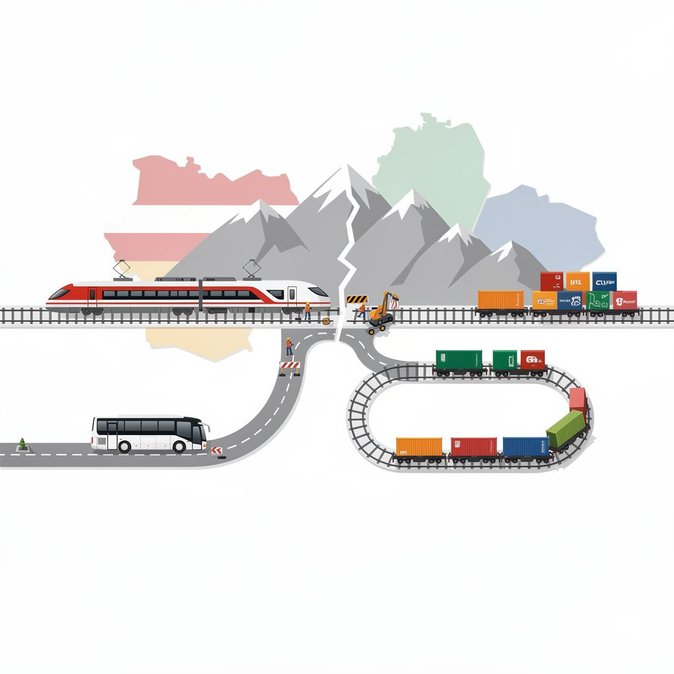
Austrian Federal Railways (ÖBB) and Italy’s Rete Ferroviaria Italiana (RFI) have confirmed that the Brenner railway—Europe’s key north-south freight and passenger artery—will shut in stages between 17 July and 16 August 2026 for emergency track and tunnel maintenance. Cross-border Eurocity and Railjet services between Innsbruck and Bolzano will be completely suspended from 18 July to 1 August, with replacement buses adding at least 30 minutes to journeys. Regional trains will terminate at Steinach am Brenner during parts of the works, and bicycles will not be carried on substitute buses—a blow for Tyrolean summer tourism.
If your rerouted itinerary requires crossing additional borders or arranging transit through non-Schengen territories, VisaHQ’s Vienna-based team can help secure the necessary travel documents quickly and online. Their platform (https://www.visahq.com/austria/) supports tourist, business and freight-related visas for more than 200 destinations, ensuring passengers and logistics managers stay compliant despite the railway disruption.
Freight operators will divert via the Tauern line or Swiss corridors, increasing kilometre-costs and risking congestion on alternative Alpine routes. Logistics managers moving automotive components between Bavaria and northern Italy should expect transit times to lengthen by up to 12 hours in peak periods. The timing, during Europe’s busiest vacation window, has drawn criticism from passenger associations, yet railway engineers argue that concentrated closures minimise overall downtime. ÖBB will use the lull to repair frost damage in the Mühltal Tunnel, while RFI renovates platforms at Brennero station and renews track at Sterzing. Businesses with just-in-time supply chains—from fashion houses in Verona to machinery exporters in Upper Austria—are advised to build additional inventory or shift volumes to road transport. However, the parallel A13 motorway is itself constrained by works on the Lueg Bridge, meaning trucking slots are scarce and subject to Tyrolean night-driving bans. The episode underscores the fragility of Alpine corridors until the Brenner Base Tunnel opens (now delayed to 2032). EU planners see the closure as further justification for accelerating financing on complementary links such as the Southern Railway and Koralm tunnels, which will give Austrian exporters alternative, lower-grade crossings in future peak seasons.
If your rerouted itinerary requires crossing additional borders or arranging transit through non-Schengen territories, VisaHQ’s Vienna-based team can help secure the necessary travel documents quickly and online. Their platform (https://www.visahq.com/austria/) supports tourist, business and freight-related visas for more than 200 destinations, ensuring passengers and logistics managers stay compliant despite the railway disruption.
Freight operators will divert via the Tauern line or Swiss corridors, increasing kilometre-costs and risking congestion on alternative Alpine routes. Logistics managers moving automotive components between Bavaria and northern Italy should expect transit times to lengthen by up to 12 hours in peak periods. The timing, during Europe’s busiest vacation window, has drawn criticism from passenger associations, yet railway engineers argue that concentrated closures minimise overall downtime. ÖBB will use the lull to repair frost damage in the Mühltal Tunnel, while RFI renovates platforms at Brennero station and renews track at Sterzing. Businesses with just-in-time supply chains—from fashion houses in Verona to machinery exporters in Upper Austria—are advised to build additional inventory or shift volumes to road transport. However, the parallel A13 motorway is itself constrained by works on the Lueg Bridge, meaning trucking slots are scarce and subject to Tyrolean night-driving bans. The episode underscores the fragility of Alpine corridors until the Brenner Base Tunnel opens (now delayed to 2032). EU planners see the closure as further justification for accelerating financing on complementary links such as the Southern Railway and Koralm tunnels, which will give Austrian exporters alternative, lower-grade crossings in future peak seasons.