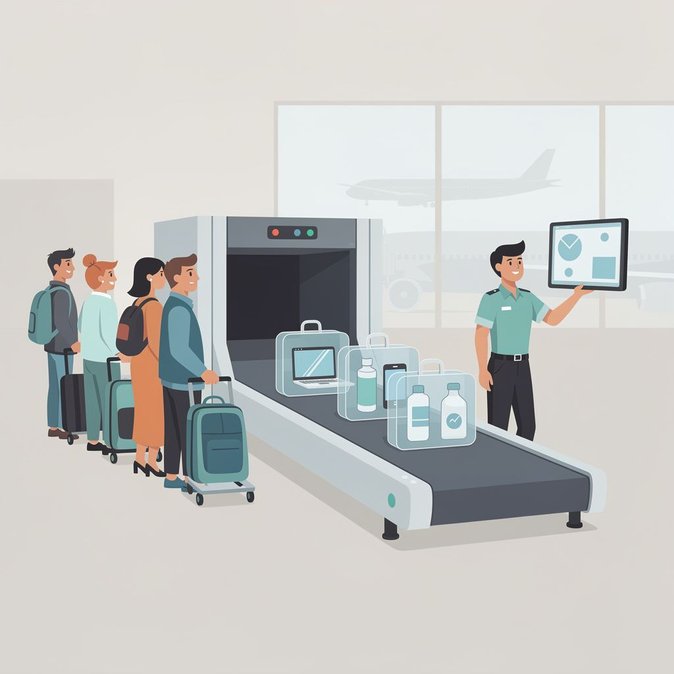
From 3 July 2026, Vienna International Airport (VIE) will switch every passenger-security lane in Terminals 1, 1A and 3 to next-generation computed-tomography (CT) scanners. The €42-million programme allows travellers to leave laptops, tablets and liquids inside their cabin bags; bottles of up to two litres will now be permitted instead of the old 100-ml rule. Similar technology is already in use at London Heathrow and Amsterdam Schiphol, but VIE is the first hub in continental Central Europe to make the leap. Flughafen Wien AG says the change should speed up the physical inspection process in the medium term, yet it warns that the first school-holiday weekend (5–7 July) could see longer wait times while staff and passengers learn the new routine. The deployment is timed to coincide with the EU’s Entry/Exit System (EES) dry-run that Austrian border police are conducting this summer. Although EES will only scan third-country passports at external Schengen borders from October 2025, Austria is already collecting feedback on biometric kiosks placed behind the new CT lanes. For travellers, this means an additional layer of data capture on peak days as police fine-tune workflows ahead of the formal go-live next year. Business-travel managers are advised to pad itineraries by at least 30 minutes next week. The airport recommends arriving two hours before intra-Schengen departures and three hours before non-Schengen flights until mid-July. Corporate mobility teams should update traveller briefings to reflect the new two-litre liquid allowance, which removes the need to buy toiletries air-side and could reduce ancillary costs. Behind the scenes, airlines must adapt their weight-and-balance calculations: heavier cabin baggage is expected because travellers no longer decant liquids into smaller containers. Low-cost carriers operating Airbus A320-family aircraft from VIE have already circulated notices reminding passengers that standard hand-luggage weight limits (8–10 kg) still apply even though the liquid rule has changed. Excess fees for overweight cabin bags therefore remain a possible pain point. Finally, the airport operator has confirmed that the CT equipment is compatible with European Civil Aviation Conference (ECAC) Standard 3, meaning that security certificates issued in Vienna will be recognised throughout the EU. That should encourage neighbouring airports in Bratislava, Budapest and Prague to accelerate their own roll-outs, easing the way for multinational companies managing cross-border commuter flows in Central Europe.
Source: The Local Austria