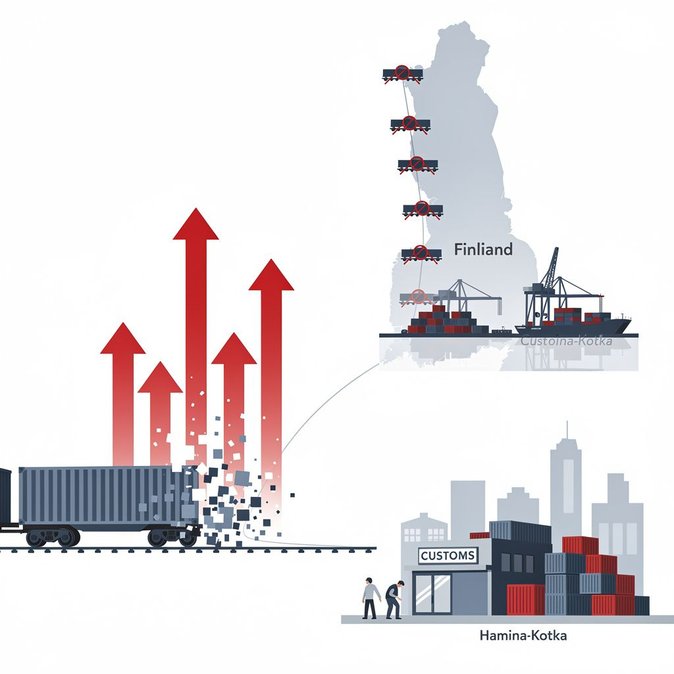
Just nine days after Moscow closed seven rail border crossings with its NATO neighbours, Finnish logistics is already feeling the pinch. A detailed report published on 9 July by the Russian customs portal TKS.ru, citing Finland’s public broadcaster Yle, says more than one hundred Finnish Customs officers stationed along the eastern rail frontier have been placed on unpaid leave as freight volumes evaporate. The Russian government decree, effective 1 July, suspended traffic at Vyborg, Värtsilä, Lyttä, St. Petersburg-Finlyandsky and Svetogorsk on the Finnish side, along with crossings into Estonia and Latvia. Although some trains can still transit via the Buslovskaya gateway, Russia simultaneously hiked rail tariffs towards Finland by a factor of eight, throttling cargo such as Kazakh grain, Russian fertilisers and timber that traditionally moved through the ports of Hamina-Kotka and Kouvola. Mikko Grönberg of Finnish Customs told Yle that the agency is monitoring the situation but hopes to redeploy staff rather than pursue lay-offs. Union representative Pekka Naski warned, however, that vacancies are mainly in Helsinki and western ports—far from the eastern towns where officers and their families live. The closures come on top of Finland’s own decision in late 2023 to seal road crossings amid a hybrid-migration dispute, leaving rail as the last operational land corridor until now. For Finnish exporters the immediate impact is higher inland freight costs and longer transit times to Asia via alternative routes through Sweden, the Baltics or Belarus. Importers of Russian raw materials—particularly fertiliser handlers at Hamina-Kotka, where such cargo made up 23 percent of 2025 throughput—face a sudden loss of volume. Freight forwarders expect spot rail rates to rise further as capacity tightens west of St Petersburg. Multinational companies with plants in south-eastern Finland should revisit just-in-time inventory models and build buffer stock, analysts say. Human-resources teams may also need to assist impacted customs employees and local service providers as the economic ripple spreads through border communities from Imatra to Joensuu.
Source: TKS.ru (citing Yle)