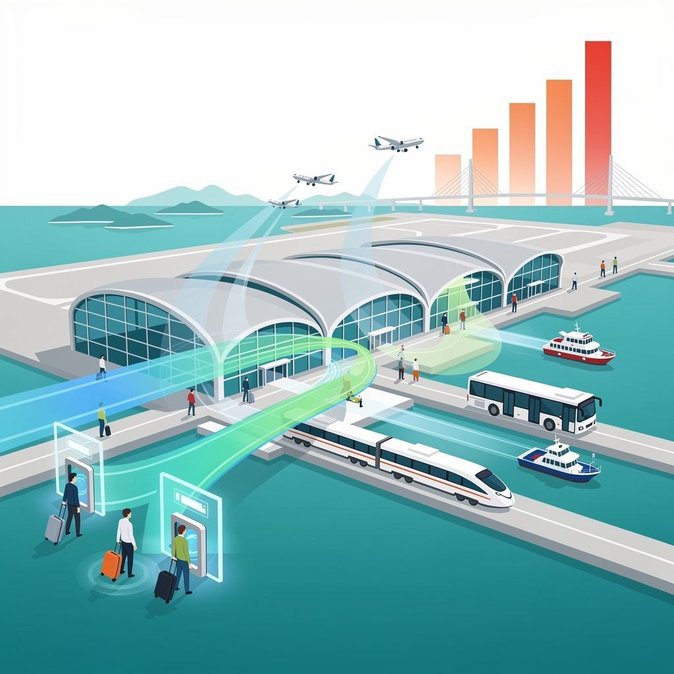
Airport Authority Hong Kong (AAHK) published its June and H1 2026 traffic report on 20 July, confirming that passenger throughput at Hong Kong International Airport (HKIA) reached 5.12 million in June—up 7.9 % year-on-year—while first-half numbers climbed 11.7 % to 32.8 million. Flight movements grew 4.4 % to just over 200,000. Transfer and transit passengers showed the strongest rebound, reflecting HKIA’s restored role as a super-connector between the Chinese Mainland and long-haul markets. Demand was led by Japan, the Pearl River Delta and an easing decline from Middle-East routes as airlines recalibrate schedules around geopolitical airspace restrictions. Cargo volumes also impressed, rising 6.8 % in June thanks to a 19.5 % leap in trans-shipment tied to Mainland e-commerce exports. The report highlights several mobility-relevant developments. First, HKIA’s “Airport City Link” sea-air intermodal service, launched in March, has cut Shenzhen–HKIA journey times to 40 minutes, broadening options for expatriate commuters. Second, the Immigration Department’s new Seamless e-Channel pilot—debuting at the Hong Kong-Zhuhai-Macao Bridge on 25 June—will be rolled out to HKIA departures by October, promising five-second contactless clearance for enrolled residents and, eventually, frequent visitor cohorts. For multinational employers operating South China hubs, the steady traffic recovery signals that ad-hoc capacity constraints (seen during last year’s Typhoon Talim) are easing. Duty travel budgets, however, will need to absorb a 12 % increase in airport charges effective 1 August as part of HKIA’s Third Runway funding plan.
Source: Airport Authority Hong Kong