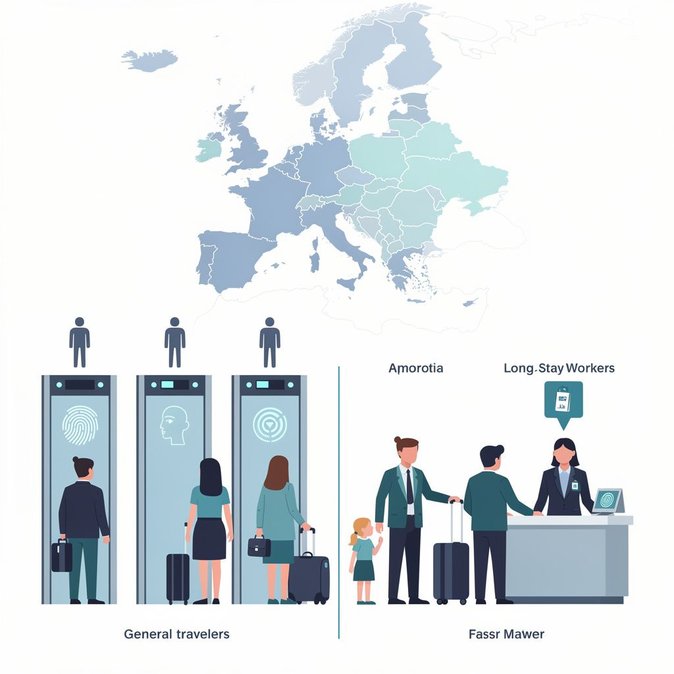
The European Commission has issued fresh guidance on which travellers are—and are not—recorded in the EU’s new Entry/Exit System (EES). In a bulletin dated 27 July 2026, Brussels reminded Member States, including Austria, that the biometric system applies only to third-country nationals entering the Schengen Area for short stays of up to 90 days in any 180-day period. Holders of long-stay visas (D-visas), family-members of EU citizens exercising free movement, freight drivers on bilateral transport permits, and accredited diplomats remain exempt. The clarification comes after several high-profile complaints at Vienna International Airport, where foreign executives holding Austrian Red-White-Red Cards were erroneously queued for fingerprinting on arrival. The Ministry of the Interior has now instructed border officers to consult the national register of residence permits before routing passengers to EES kiosks. For global mobility managers the note is timely. Since EES went live on 10 April 2026, companies have reported lengthier queues and confusion about whether staff on local contracts need to use the new self-service gates. The Commission urges employers to brief travellers: short-term business visitors from visa-waiver countries (e.g., the US, UK, Canada) must enrol fingerprints and a facial image at first entry; holders of Austrian D-visas or residence cards should proceed to the manned desks. The guidance also flags upcoming interoperability with the European Travel Information and Authorisation System (ETIAS), still scheduled for Q4 2026. Once ETIAS is active, pre-travel authorisations will be matched in real time with EES records, further automating overstay detection. Until then, Austria will continue to stamp residence cards manually to ensure legal certainty for posted workers and intra-company transferees. Businesses running commuter programmes into Austria—particularly from the Western Balkans—should update their mobility policies immediately, ensuring that staff carry proof of exemption (e.g., residence permits) and understand which lane to choose. Failure to register correctly can trigger an automatic overstay warning and complicate future Schengen travel.