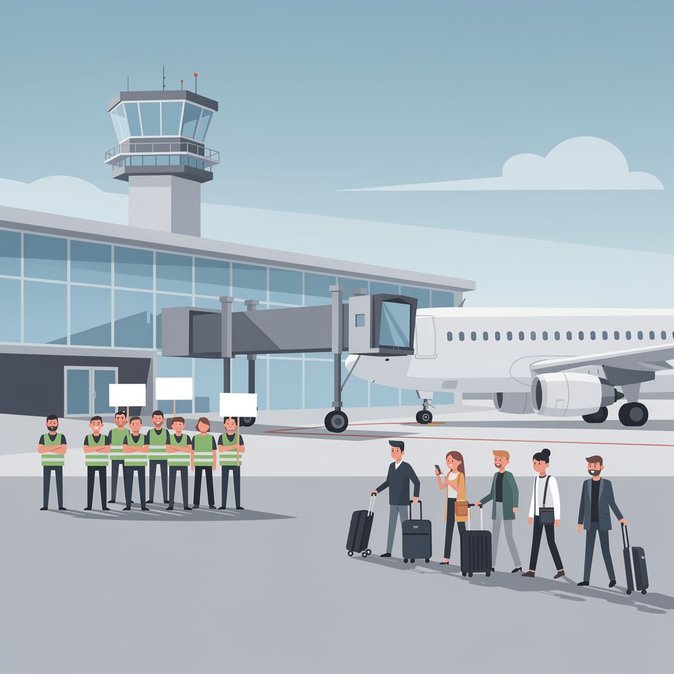
Trade‐union representatives at Václav Havel Airport Prague announced late on 30 July 2026 that they have entered a formal state of “strike readiness” after several rounds of wage-review talks with airport management failed to yield agreement. In practical terms, the declaration is a warning signal rather than an immediate work stoppage: under Czech labour law, unions must give at least 72 hours’ notice of any concerted industrial action. According to the airport’s media centre, all terminals, security checkpoints, and ground-handling units are operating normally and contingency rosters have been activated to ensure that passenger processing times are unaffected. The airport handled 36,000 travellers on Tuesday and expects a similar volume today as the main summer-holiday wave peaks. For the roughly 250 multinational companies that maintain corporate shuttles or frequent-flyer programmes through Prague, uninterrupted service is critical; many moved meetings to other hubs during the 2024 baggage-handler strike in Germany and are watching this development closely. Behind the dispute is the sharp recovery of Czech aviation: airport revenues exceeded pre-pandemic levels for the first time in 2025, yet unions argue that real wages for ramp agents, security staff, and maintenance engineers have lagged behind inflation. Management counters that it has already budgeted a 7 % average salary increase this year and cannot absorb the double-digit rise demanded without raising airport charges for airlines. Higher charges would ultimately feed through to ticket prices and could erode Prague’s cost advantage over neighbouring Vienna and Munich. For global-mobility managers the immediate takeaway is that no flights are currently cancelled, but contingency planning is advisable. Companies with time-critical cargo or personnel moves should identify alternative routings via Brno or Dresden and verify that travel insurance covers industrial-action delays. Travellers departing Prague this weekend are advised to arrive the usual two hours before Schengen flights and three hours before long-haul departures. The airport has published live updates on its website and via its Twitter feed @PragueAirport. If negotiations fail and a strike is formally called, the legal minimum service requirement (30 % staffing of essential security posts) would still allow a reduced schedule of departures, but peak-hour congestion could produce knock-on delays across the Schengen network. Employers with large expatriate populations in Czechia should brief staff on possible schedule changes and maintain up-to-date mobile contact lists so that duty-of-care alerts can be issued quickly.