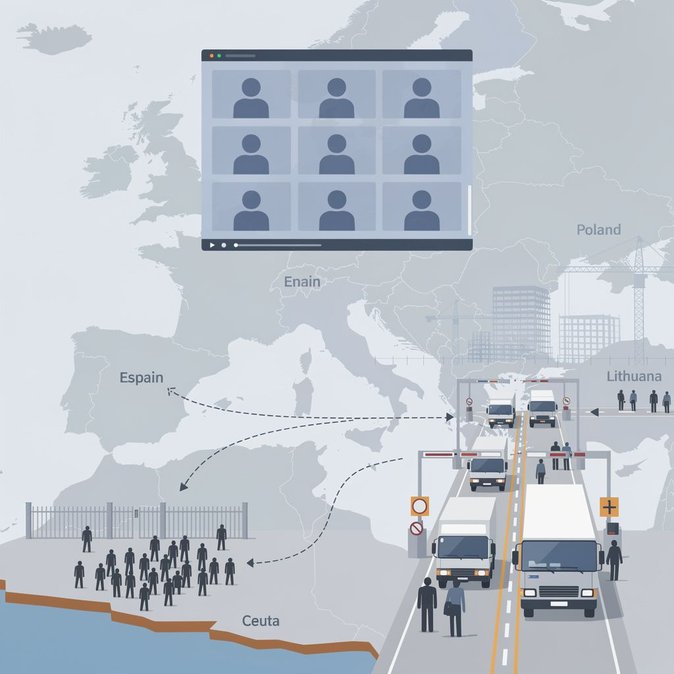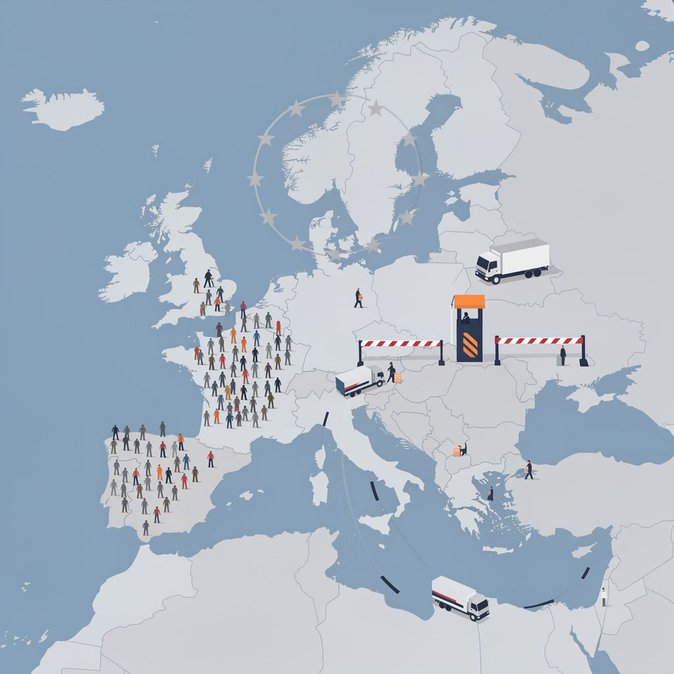
Poland’s Interior Minister Tomasz Siemoniak dialled into an extraordinary video-conference of the 27 EU interior ministers on 4 August after last week’s unprecedented mass crossing of almost 50,000 people from Morocco into Spain’s North-African enclave of Ceuta. Warsaw had already co-signed—together with 21 other capitals—a blunt letter accusing Madrid of creating “pull factors” by offering a broad regularisation plan for undocumented migrants resident in Spain. The Polish government argues that decisive external-border action is the only way to preserve business confidence in the Schengen Area and safeguard road-freight and passenger flows that are critical to the Polish export sector. Speaking to reporters before the call, Siemoniak drew a direct parallel between the Ceuta events and the “hybrid” migration pressure that Poland has faced on its land frontier with Belarus since 2021. “If thousands can be marshalled in North Africa one day, they can be marshalled on our eastern border the next,” he warned, urging the Commission to authorise emergency funding for physical barriers, surveillance drones and rapid Frontex deployments. Inside the meeting, Warsaw pushed for a new legal instrument that would allow member states to re-impose internal Schengen checks for up to twelve months without prior Brussels approval whenever a neighbouring country “instrumentalises” migration. For Polish multinationals such as PKP Cargo, Orlen and LOT Polish Airlines, the political drama goes beyond border fencing. The Ceuta crisis has already triggered informal German spot-checks on truck traffic from Poland, delaying just-in-time deliveries to Western European plants. Automotive supplier Valeo, which operates four factories in southern Poland, told investors on Tuesday that even a minor hardening of German-Polish border controls could increase transit times by 30 percent and force it to boost warehouse stocks. Business lobbies are therefore pressing Warsaw to ensure that any new EU measures remain temporary, targeted and technology-driven rather than blanket physical closures. Migration-law specialists note that Poland’s hard line comes at a sensitive domestic moment. On 1 September, the temporary protection regime for many Ukrainian refugees will begin to phase out; employers fear fresh paperwork bottlenecks just as the high-season harvest picks up. By championing stricter external borders, the government hopes to insulate itself from criticism by right-wing opposition parties that contend Warsaw has been too generous with work permits. Yet corporates warn that over-securitisation could deter much-needed non-EU talent from choosing Poland as an assignment hub. What happens next? The Irish Council presidency will circulate a discussion paper in mid-August, ahead of an extraordinary Justice and Home Affairs Council in Brussels on 26 August. Diplomats say Warsaw is working with Berlin and Copenhagen on compromises that would couple tougher external-border tools with faster intra-EU mobility lanes for vetted business travellers. If that twin-track approach prevails, Polish companies could gain both greater security on their eastern flank and smoother logistics on their western one—an outcome the export-heavy economy badly needs.
Source: Le Monde