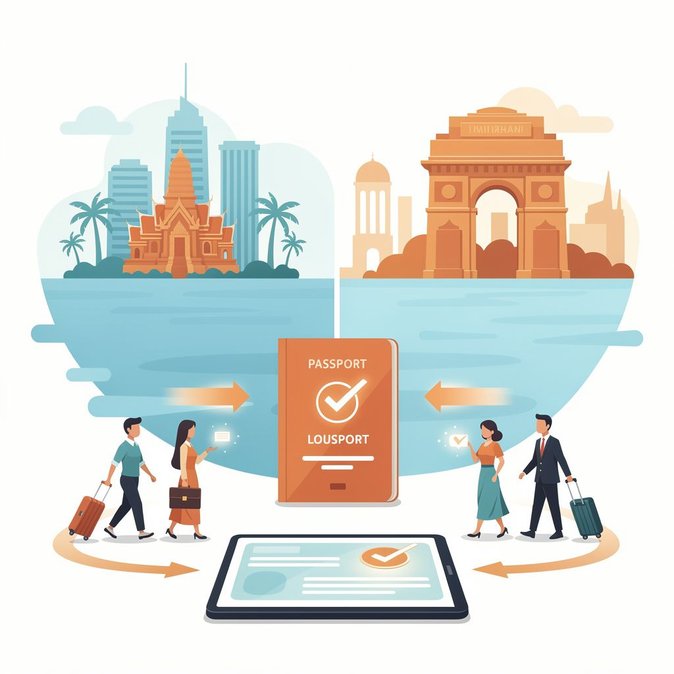
In a bid to turbo-charge arrivals from Southeast Asia, the Government of India has scrapped the ₹1,000 (approx THB 430) processing fee that Thai passport-holders normally pay for a 30-day double-entry e-Tourist Visa. The waiver, announced by the Indian Embassy in Bangkok on 11 September and confirmed by the Ministry of Home Affairs on 14 September, took effect immediately and will run until at least 31 December 2027. Travellers must still apply online via the official e-Visa portal and obtain an Electronic Travel Authorisation before boarding, but no government fee will be charged. Thailand has consistently ranked among India’s top 15 inbound markets, but volumes have yet to rebound to pre-pandemic highs. By eliminating the visa fee—and retaining a generous double-entry facility—New Delhi hopes to lure back leisure travellers who may otherwise choose short-haul, fee-free destinations such as Vietnam or Malaysia. Airlines are already responding: Thai AirAsia X says it will up-gauge its Bengaluru and Kolkata rotations for the Diwali peak, while IndiGo is scouting for slots to restore Bangkok–Varanasi. Travel trade bodies expect the cost saving to shave roughly 3-4 % off a typical week-long India itinerary for Thai groups. The measure is also being read as a goodwill gesture ahead of the next round of negotiations on the Indo-Thai free-trade agreement. Tourism officials in both countries have signalled that reciprocal concessions—potentially a limited visa-on-arrival pilot for Indians—could be on the table if arrival numbers hold steady. The Thai Travel Agents Association told India Today that its members are already repackaging popular spiritual-circuit tours (Bodh Gaya, Sarnath, Kushinagar) and beach add-ons in Goa and Andaman. For global-mobility and corporate-travel managers, the waiver simplifies short-notice trips for Thai executives attending meetings in India’s manufacturing hubs. Because the e-Tourist Visa permits certain business activities—such as attending conferences or exploratory visits, provided no remuneration is drawn—companies can avoid the longer lead times associated with a formal Business Visa. HR teams should, however, remind travellers that the fee waiver does not confer visa-free status; carriers will still deny boarding without an approved e-Visa. Immigration experts caution that documentation requirements remain unchanged. Applicants must upload a recent photograph and a passport valid for at least six months; overstays incur a US-$300 penalty and possible future ban. Corporations should update their travel-policy matrices to reflect the nil-fee category and adjust cost projections for Thai-origin trips booked between now and end-2027.
Source: India Today