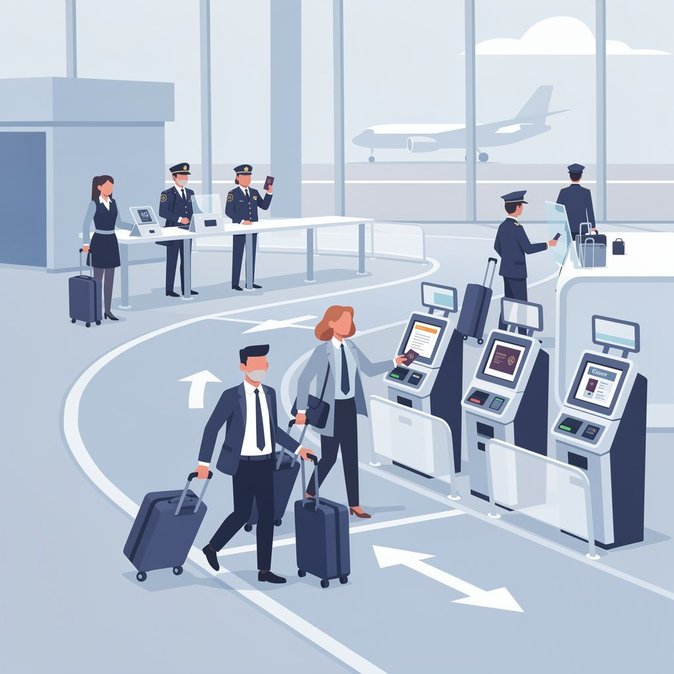
Business and leisure travelers landing at Václav Havel Airport Prague from outside the Schengen Area have been hit by markedly longer waits at passport control since mid-September. In a post published on 22 September, relocation advisory firm Foreigners.cz reported that some passengers arriving at Terminal 1 have spent "several hours" in line, prompting the airport to urge flyers to build in extra buffer time to their itineraries. The main culprit is the full switch-on of the EU’s Entry/Exit System (EES) on 10 April 2026. EES electronically registers every third-country national who enters or exits the Schengen Area for short stays, capturing fingerprints and a facial image at the first point of entry. While the system is designed to speed up repeat crossings and tighten over-stay enforcement, it adds roughly 30–45 seconds of processing time per first-time traveler. When several long-haul flights land back-to-back, the bottleneck quickly mushrooms. Prague Airport and the Czech National Police have responded by fast-tracking a €6 million expansion of the Terminal 1 border-control zone. Work began this month and will run through April 2027, eventually adding five staffed booths, four EasyGoGate e-gates and an enlarged queuing area. In the meantime, the airport is publishing live wait-time estimates on its website and social channels, and encouraging employers, relocation providers and travel managers to alert assignees in advance. For globally-mobile staff, the practical advice is clear: allow at least two extra hours between scheduled arrival and any onward meetings or connecting ground transport; confirm which travel document you will enter on (EES does not apply to holders of Czech long-term visas or residence permits); and, if possible, schedule arrivals outside the early-morning and late-afternoon peaks when wide-body traffic from Asia and North America lands. Relocation firms say they are already re-sequencing first-day orientation programmes to account for the delays. Although the queues are inconvenient, mobility specialists view them as teething pains rather than a long-term deterrent. "Once the biometric database fills up and the new booths are open, Prague should regain its reputation for fast processing," says Petr Novák, a partner at Move2CZ Consulting. Until then, employers are being urged to keep an eye on flight schedules and manage transferee expectations accordingly.
Source: Foreigners.cz Blog