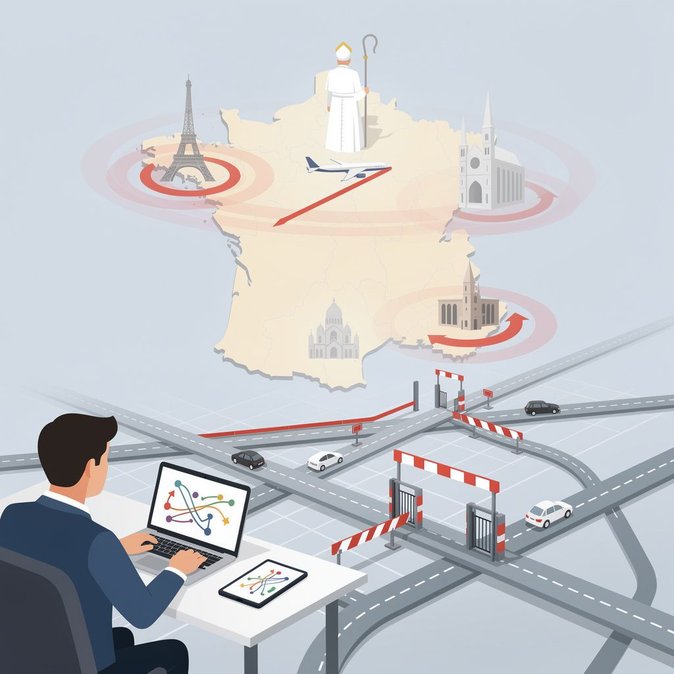
France concluded the four-day visit of Pope Léon XIV on 28 September amid an unprecedented security and mobility operation spanning three regions. An air-defence order published by the Ministry of the Armed Forces activated a low-altitude exclusion zone stretching 110 km around Lourdes from 26 to 27 September, prohibiting drones and general aviation flights (“ZIT PAPE”). Similar restrictions applied over Paris and Metz during open-air masses that drew more than 600 000 pilgrims. On the ground, more than 2 500 national-police officers, 15 CRS mobile-force units and the elite RAID team secured perimeters around the Lourdes sanctuary and Metz-Nancy-Lorraine Airport. Local authorities in Lourdes required all inbound vehicles to display colour-coded access stickers between 26 September 10:00 and 28 September 07:30; violators faced on-the-spot fines and towing. Park-and-ride hubs with free shuttles were set up outside the city to prevent gridlock on the A64 and departmental roads. Air France operated three special A321 flights for the pontifical delegation between Rome, Paris-Orly, Tarbes-Lourdes, and Metz. Commercial services at Tarbes-Lourdes-Pyrénées Airport were suspended for six-hour windows surrounding papal movements, triggering re-routing of DHL and FedEx freighters to Toulouse-Blagnac. While the event concluded without major incident, the scale of the measures offers a preview of France’s “Grand-Événement” framework created after the 2024 Immigration Control & Integration Law. Companies planning corporate meetings or incentive travel around large religious or sporting gatherings should anticipate pop-up no-fly zones, mandatory vehicle badging and ad-hoc border checks. Mobility advisers should monitor the Official Journal (JORF) for future decrees enacted under Article L.211-11-1 of the Internal Security Code.