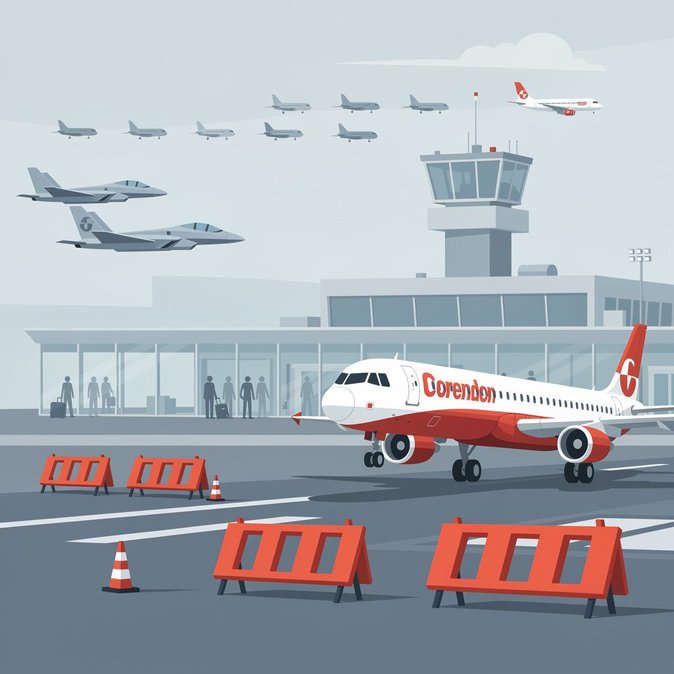
A routine holiday flight from Corfu to Nuremberg turned into a full-scale security incident on 13 October when a Boeing 737-800 operated by Corendon Airlines accidentally transmitted the international hijack code. German air-traffic controllers immediately alerted the Bundeswehr’s quick-reaction force, and two Eurofighter jets were scrambled from Neuburg an der Donau to intercept the aircraft as it crossed Austrian airspace. In parallel, Nuremberg Airport was closed to all traffic and sealed off by federal and state police, while fire-fighting and medical units were positioned on standby along the runway. According to Corendon, the crew experienced a short-lived radio malfunction and, while cycling through emergency codes, inadvertently set the transponder to 7500—the signal for an unlawful interference situation. The pilots regained communications within minutes, but the protocol required the fighter escort to continue until landing. The jet touched down safely at 12:35 p.m. local time; passengers were kept on board for thirty minutes while special-forces officers confirmed that no threat existed. No injuries were reported. For travellers the event is a reminder that even minor technical glitches can cascade into major operational disruptions. All outbound departures from Nuremberg were delayed for up to two hours, and at least seven inbound flights diverted to Munich and Stuttgart, forcing hundreds of business travellers onto already-busy rail links. Travel managers with personnel transiting secondary German airports should review contingency plans, particularly as heightened security postures linked to Germany’s temporary internal-border controls have reduced the tolerance for ambiguity in cockpit communications. Aviation-security experts praised the rapid, well-rehearsed response but warned that stricter cockpit procedures around transponder code changes may be required. Airlines flying into Germany can expect the Luftfahrt-Bundesamt to issue an air-safety bulletin in the coming days, and crews may face extra verification calls from ATC when changing squawk codes over the Alpine flight corridor. While the incident ended benignly, it underscores how quickly perceived threats can ripple through the national transport network, affecting corporate mobility far beyond the immediate airport.
Source: Associated Press