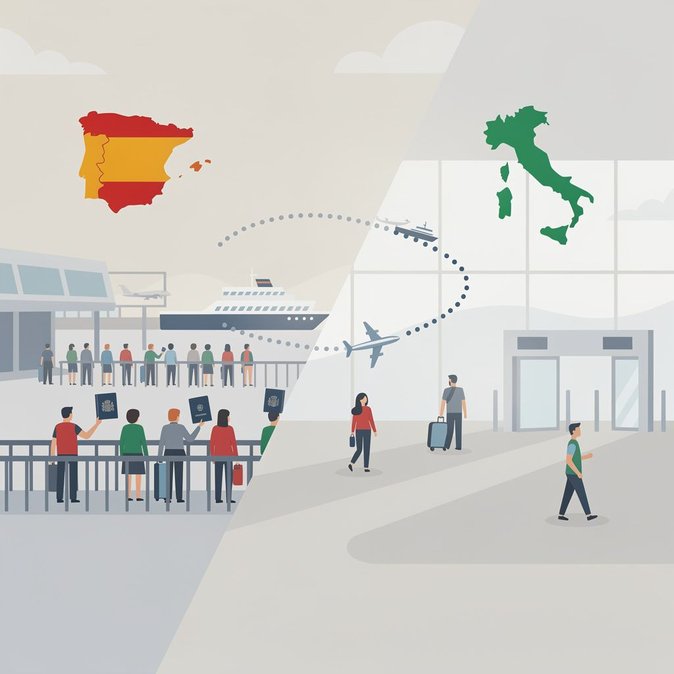
Spain and Italy formally agreed on 22 October 2026 to lift the temporary border controls that had been re-introduced in August at all air and sea crossings between the two countries. The checks were imposed after a sudden influx of migrants into Spain’s north-African enclave of Ceuta prompted Rome to screen travellers arriving from Spain, with Madrid responding in kind a few days later. During the summer, the reciprocal controls caused long passport queues at Barcelona-El Prat, Madrid-Barajas, Rome Fiumicino and Milan Malpensa, affecting an estimated 3.7 million leisure and business passengers and obliging airlines to reschedule block times. According to Spain’s Interior Ministry, yesterday’s decision follows “a detailed joint security assessment” and will be accompanied by an enhanced real-time exchange of passenger-name-record (PNR) data and mobile biometric spot-checks rather than systematic screening. Travellers coming off evening flights from Milan to Madrid reported that booths were dismantled within hours of the announcement. Italian Interior Minister Matteo Piantedosi said that both countries would now focus on “intelligence-led policing” instead of fixed controls, in line with recent Commission guidance on proportionate Schengen suspensions. For multinational companies, the rollback restores true intra-Schengen freedom of movement for executives commuting between the two Mediterranean economies and eliminates the need to carry supporting business-travel documentation that had been requested during the ad-hoc checks. Logistics firms moving urgent automotive and pharma components by belly-hold cargo also expect faster turn-arounds because handlers no longer need to segregate Spain–Italy shipments for secondary inspection. However, mobility teams should note that both governments reserve the right to reactivate controls should a similar migration spike re-occur. Employers with frequent Spain–Italy traffic are therefore advised to keep passports valid for at least six months, maintain digital copies of itineraries and monitor AENA and ENAC airport alerts. Spanish authorities also reminded carriers that the EU’s Entry/Exit System (EES) remains fully operational for non-EU nationals, and that airlines must continue to verify biometric enrolment before boarding. Industry bodies such as the European Travel Managers Association (ETMA) welcomed the move, calling it “a necessary return to predictability for corporate road-warriors at a critical budgeting period for 2027”. ForwardKeys data already show a 14 % week-on-week jump in Spain–Italy flight searches in the hours following the news.
Source: El País