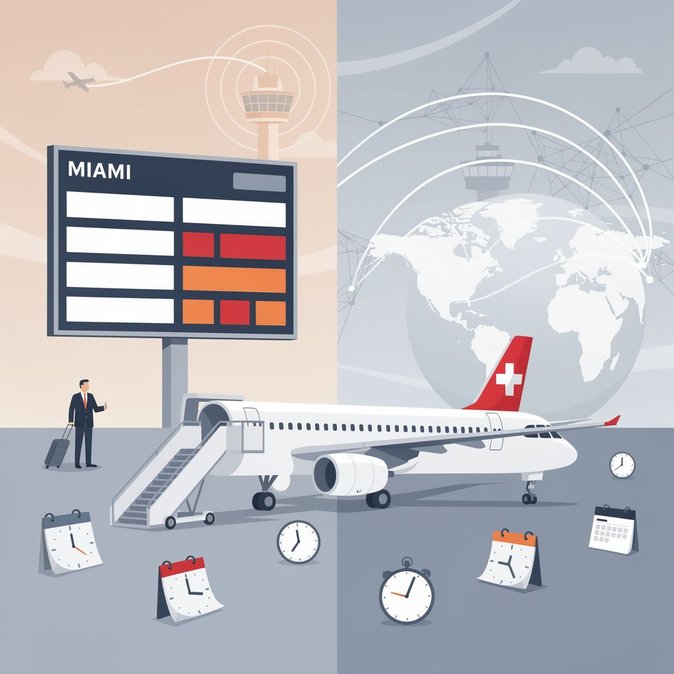
A rare nationwide ground-stop by the US Federal Aviation Administration (FAA) late on 13 November rippled across the Atlantic and immediately disrupted Swiss corporate itineraries. When ATC technicians switched a regional facility from copper to fibre lines, a misconfigured router flooded the network and forced the FAA to halt all domestic departures for just over four hours. Although the stoppage was lifted at 02:19 Swiss time on 14 November, SWISS flight LX67 had already missed its crew duty window and the airline cancelled the Miami–Zurich rotation. Two-class Boeing 777 crews must legally rest before starting a new duty period, so the aircraft and its 330 passengers remained overnight in Florida. SWISS accommodated travellers in hotels and began re-booking them on the first available services. Because the flight originated outside Europe, compensation rules are complex. The Swiss Federal Office of Civil Aviation (FOCA) confirmed that EU261 protections apply only when the *operating* carrier is European; customers ticketed on codeshares operated by US airlines have refund rights under US DoT regulations but no fixed lump-sum payment. SWISS therefore urged passengers to keep receipts for out-of-pocket hotel, meal and ground transport costs, which remain reimbursable even in "extraordinary circumstances" such as ATC failures. Corporations with global mobility programmes felt the knock-on effects over the weekend. The same 777 was scheduled to operate LX40 Zurich–Los Angeles on 14 November and departed 3½ hours late, forcing several onward connections to be re-ticketed. Travel managers were reminded to monitor crew-duty constraints whenever large-scale ATC outages occur—re-routing travellers onto carriers that still have rested crews can avoid an overnight stay. Although the FAA quickly ruled out a cyber-incident, US Transportation Secretary Sean Duffy told reporters that chronic under-funding of legacy infrastructure contributed to the outage. Swiss HR directors with US assignees should therefore expect further modernisation works—and potential intermittent ground-stops—over the next two years. Contingency planning that allows a 24-hour recovery window now forms part of several Swiss multinationals’ travel risk policies. Finally, mobility specialists note that the incident again spotlighted the patchwork nature of passenger-rights legislation. A European traveller flying the same route on an American carrier would not have the same entitlements as one on SWISS, despite landing at the identical Swiss destination. Employers are advised to brief travellers on claim procedures that differ between EU261, Swiss and US rules before year-end peak travel begins.
Source: JournalPlus