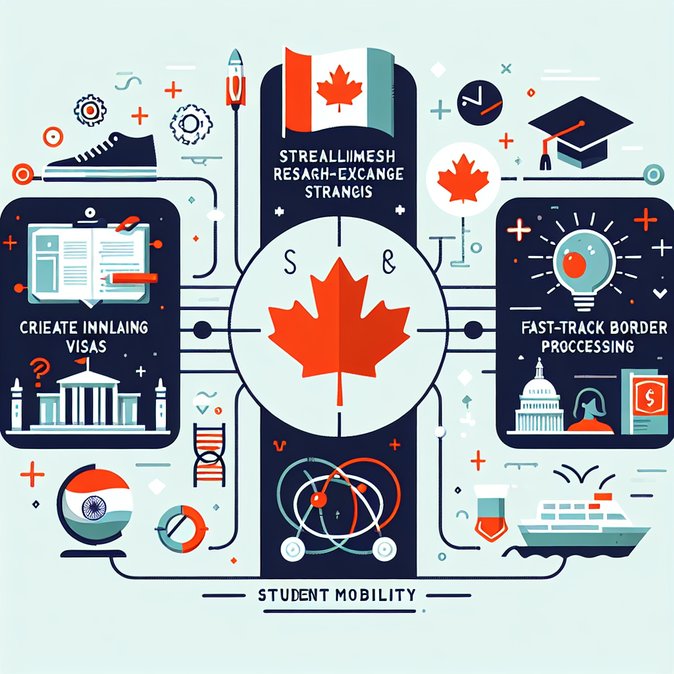
During a stop in Mumbai on 28 February 2026, Foreign Affairs Minister Anita Anand unveiled the Canada-India Talent and Innovation Strategy – a private-sector-led roadmap backed by Global Affairs Canada and signed by 13 Canadian universities and colleges. The initiative promises streamlined visa facilitation for short-term research exchanges, co-op placements and joint AI laboratories, with the explicit goal of moving people as seamlessly as data and capital. Under the four-pillar plan, Canadian institutions will embed faculty and recruiters in India’s priority sectors – clean tech, biotech and advanced manufacturing – while India’s top engineering institutes will open ‘sister campuses’ in Ontario and British Columbia. Universities Canada says the framework should double two-way student flows to 50,000 by 2030 and could eventually support hybrid credentials where credits earned in Mumbai automatically transfer to Montreal. For mobility managers, the most immediate win is a commitment by both governments to pilot a 10-day processing standard for research and internship visas, along with a dedicated border-service lane at Toronto Pearson and Delhi’s IGI airports for programme participants. Employers that rely on graduate-level STEM talent could soon tap a larger pool of bilingual (English-Hindi) candidates with Canadian work experience via post-graduation work permits. The strategy also hedges against Ottawa’s recent tightening of overall study-permit quotas. By shifting focus to postgraduate research exchanges – which remain uncapped – universities can keep high-value talent pipelines open even as undergraduate intakes plateau. Longer term, the agreement dovetails with Canada’s Indo-Pacific Strategy, positioning Canadian campuses as launch pads for companies seeking R&D footholds in India’s fast-growing tech hubs. Industry analysts note that India already supplies roughly 40 % of Canada’s international students. “Deepening academic and labour-mobility links adds resilience to the bilateral relationship at a time when each side is re-balancing economic dependencies,” says Dr. Manjula Batra, a Toronto-based higher-education consultant.
Source: Global Affairs Canada