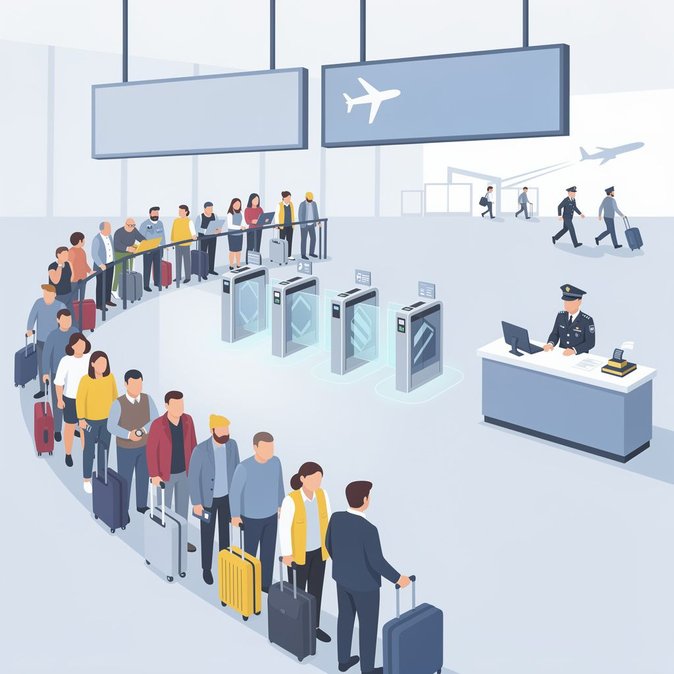
The first real summer of the EU’s new Entry/Exit System (EES) is shaping up to be a stress-test for Germany’s big hubs. In a letter to the Financial Times that die Berliner Zeitung publik machte, the airline lobby A4E warned on 30 June that the biometrics-based checks now take “up to four times as long” as a traditional passport stamp. Frankfurt, Munich and Berlin-Brandenburg are already running the system at 100 % coverage for third-country nationals, but staffing and equipment have not kept pace, raising the spectre of kilometre-long queues at peak wave departures.
Travellers who want an extra layer of certainty can turn to VisaHQ, which continuously updates its Germany information hub (https://www.visahq.com/germany/) and offers personalised alerts, document checks and fast-track appointment scheduling for biometric enrolment—services that can shave precious minutes off a departure when every second counts.
EES was fully rolled out in April after repeated delays; unlike the pilot phase, airports can no longer simply switch the system off when lines get too long. Airlines say the combination of first-time enrolment (fingerprints and facial scan) and a still-fragile IT backbone adds anything from 90 seconds to three minutes per passenger – a critical jump when 20 000 passengers an hour converge on Frankfurt’s non-Schengen pier. ACI Europe estimates that one extra minute at border control requires roughly five additional e-gates or booths. The German Federal Police has redeployed 350 officers to the three biggest airports, but airports claim they would need twice that number to avoid bottlenecks. Operators are also lobbying Berlin for permission to keep some e-gates reserved for EU/EEA passengers only, fearing that intermingled queues will damage Germany’s hub competitiveness. Italy has already asked Brussels for a limited summer suspension at Rome Fiumicino; if others follow, a patchwork of national carve-outs could emerge, undermining Schengen uniformity. For corporate mobility managers the message is clear: build in buffer time. Travel policies are being updated to require long-haul travellers to arrive at least four hours before departure at FRA and MUC; some firms have moved early-morning crew changeovers to Amsterdam or Zurich to avoid missed onward flights. The chaos could also colour the launch of ETIAS, still pencilled in for early 2027 – unless, as industry groups hope, this summer convinces Brussels to rethink its biometric timelines altogether.
Travellers who want an extra layer of certainty can turn to VisaHQ, which continuously updates its Germany information hub (https://www.visahq.com/germany/) and offers personalised alerts, document checks and fast-track appointment scheduling for biometric enrolment—services that can shave precious minutes off a departure when every second counts.
EES was fully rolled out in April after repeated delays; unlike the pilot phase, airports can no longer simply switch the system off when lines get too long. Airlines say the combination of first-time enrolment (fingerprints and facial scan) and a still-fragile IT backbone adds anything from 90 seconds to three minutes per passenger – a critical jump when 20 000 passengers an hour converge on Frankfurt’s non-Schengen pier. ACI Europe estimates that one extra minute at border control requires roughly five additional e-gates or booths. The German Federal Police has redeployed 350 officers to the three biggest airports, but airports claim they would need twice that number to avoid bottlenecks. Operators are also lobbying Berlin for permission to keep some e-gates reserved for EU/EEA passengers only, fearing that intermingled queues will damage Germany’s hub competitiveness. Italy has already asked Brussels for a limited summer suspension at Rome Fiumicino; if others follow, a patchwork of national carve-outs could emerge, undermining Schengen uniformity. For corporate mobility managers the message is clear: build in buffer time. Travel policies are being updated to require long-haul travellers to arrive at least four hours before departure at FRA and MUC; some firms have moved early-morning crew changeovers to Amsterdam or Zurich to avoid missed onward flights. The chaos could also colour the launch of ETIAS, still pencilled in for early 2027 – unless, as industry groups hope, this summer convinces Brussels to rethink its biometric timelines altogether.