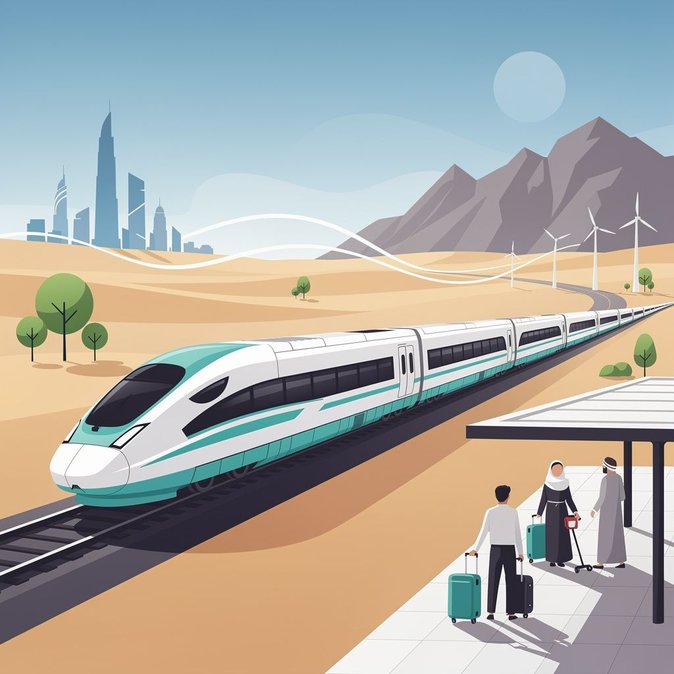
Hot on the heels of its inaugural passenger journey on 30 June, Etihad Rail has opened public ticket bookings for the 256-kilometre Abu Dhabi–Fujairah route – the first operational leg of the UAE’s long-awaited national rail network. More than 10,000 seats were snapped up within 48 hours of the booking portal going live on 1 July, signalling robust pent-up demand for an alternative to inter-emirate car and coach travel. Trains will make the end-to-end trip in **100 minutes**, cruising at 200 km/h and stopping at Al Ain on the way. Fares start at Dh50 (standard) and Dh95 (business class), undercutting average ride-hailing costs on the same corridor by more than half. The service will initially run six daily rotations but is expected to scale up to 12 by September.
For overseas visitors eager to try the new rail route, securing the right entry paperwork is just as important as booking a seat. VisaHQ’s step-by-step online service (https://www.visahq.com/united-arab-emirates/) quickly matches travellers with the appropriate UAE visa, handles the application logistics and provides real-time status updates—ensuring that your passport is travel-ready long before the train whistle blows.
For the mobility ecosystem, the launch is transformative. Logistics managers predict relief on the congested E-11 and E-84 highways, while multinationals with split offices in Abu Dhabi Global Market and Fujairah Free Zone see fresh scope for same-day meetings. HR teams can now include rail allowances in travel policy, and relocation firms anticipate that dual-city commuters will widen their housing search areas. Etihad Rail’s rollout timetable shows Dubai and Al Dhaid stations coming online by 30 September, Al Dhafra by year-end and Sharjah by March 2027 – effectively knitting all seven emirates into a two-hour rail ring. Integration talks with Dubai Metro and Abu Dhabi’s future light-rail system are under way, raising the prospect of seamless, carbon-saving door-to-door journeys for residents, tourists and cross-border workers. The project dovetails with federal Net-Zero 2050 goals and positions the UAE as a multimodal test-bed ahead of Saudi Arabia’s wider-gauge GCC Railway. Corporate mobility planners would be wise to map employee flows against forthcoming station openings and renegotiate accommodation packages accordingly.
For overseas visitors eager to try the new rail route, securing the right entry paperwork is just as important as booking a seat. VisaHQ’s step-by-step online service (https://www.visahq.com/united-arab-emirates/) quickly matches travellers with the appropriate UAE visa, handles the application logistics and provides real-time status updates—ensuring that your passport is travel-ready long before the train whistle blows.
For the mobility ecosystem, the launch is transformative. Logistics managers predict relief on the congested E-11 and E-84 highways, while multinationals with split offices in Abu Dhabi Global Market and Fujairah Free Zone see fresh scope for same-day meetings. HR teams can now include rail allowances in travel policy, and relocation firms anticipate that dual-city commuters will widen their housing search areas. Etihad Rail’s rollout timetable shows Dubai and Al Dhaid stations coming online by 30 September, Al Dhafra by year-end and Sharjah by March 2027 – effectively knitting all seven emirates into a two-hour rail ring. Integration talks with Dubai Metro and Abu Dhabi’s future light-rail system are under way, raising the prospect of seamless, carbon-saving door-to-door journeys for residents, tourists and cross-border workers. The project dovetails with federal Net-Zero 2050 goals and positions the UAE as a multimodal test-bed ahead of Saudi Arabia’s wider-gauge GCC Railway. Corporate mobility planners would be wise to map employee flows against forthcoming station openings and renegotiate accommodation packages accordingly.