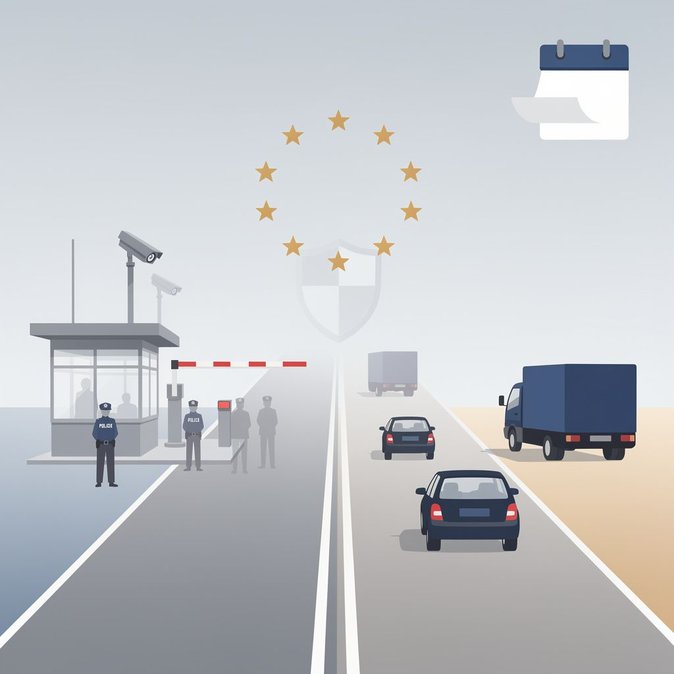
A month after issuing formal opinions on the legality of prolonged internal border controls, the European Commission has singled out Austria and eight other Schengen members for keeping checkpoints that were originally reintroduced as emergency measures. Although Austria’s controls on its Hungarian and Slovenian borders have been repeatedly renewed since 2015, Brussels now argues that new tools created by the EU Asylum & Migration Pact, together with the bloc-wide biometric Entry/Exit System, offer less intrusive alternatives.
Travellers and corporate mobility planners who need clarity on which passports, visas or residence permits will be required under the shifting regime can consult VisaHQ’s dedicated Austria page. The service aggregates the latest policy updates and provides step-by-step assistance with applications, ensuring employees and freight drivers remain compliant even as Vienna adjusts its border procedures.
In its assessment, published 2 June 2026 but taking effect at the next renewal cycle on 11 July, the Commission states that Vienna must present a “road map with measurable milestones” for phasing out fixed controls. The document notes that irregular border crossings along the Western Balkan route fell by 40 percent in the first four months of 2026, weakening Austria’s justification of “continued migration pressure.” For businesses, the recommendation is more than political symbolism. Trucking associations estimate that the 15-minute average delay on the A2 Spielfeld crossing costs the export sector €3.4 million in lost productivity each quarter. Commuter flows between Graz and Maribor involve roughly 9,000 frontier workers—many employed by automotive suppliers who rely on just-in-time delivery schedules. Austria’s Interior Ministry responded that it would “analyse the opinion carefully” but insisted that the security situation along the Balkan corridor remains volatile. Should Vienna comply, controls could gradually revert to mobile police patrols away from the border line, supplemented by number-plate recognition and data sharing through Frontex’s new European Border Surveillance System. Corporate mobility managers are advised to monitor renewal notices closely. If Austria drops fixed checks, ID spot-checks may still occur up to 30 kilometres inside national territory, so employees should continue to carry passports or EU ID cards. Logistics firms should also track any pilot programs for “Green Lanes” that allow pre-cleared cargo to bypass queues—a measure Brussels floated as a condition for removing barriers.
Travellers and corporate mobility planners who need clarity on which passports, visas or residence permits will be required under the shifting regime can consult VisaHQ’s dedicated Austria page. The service aggregates the latest policy updates and provides step-by-step assistance with applications, ensuring employees and freight drivers remain compliant even as Vienna adjusts its border procedures.
In its assessment, published 2 June 2026 but taking effect at the next renewal cycle on 11 July, the Commission states that Vienna must present a “road map with measurable milestones” for phasing out fixed controls. The document notes that irregular border crossings along the Western Balkan route fell by 40 percent in the first four months of 2026, weakening Austria’s justification of “continued migration pressure.” For businesses, the recommendation is more than political symbolism. Trucking associations estimate that the 15-minute average delay on the A2 Spielfeld crossing costs the export sector €3.4 million in lost productivity each quarter. Commuter flows between Graz and Maribor involve roughly 9,000 frontier workers—many employed by automotive suppliers who rely on just-in-time delivery schedules. Austria’s Interior Ministry responded that it would “analyse the opinion carefully” but insisted that the security situation along the Balkan corridor remains volatile. Should Vienna comply, controls could gradually revert to mobile police patrols away from the border line, supplemented by number-plate recognition and data sharing through Frontex’s new European Border Surveillance System. Corporate mobility managers are advised to monitor renewal notices closely. If Austria drops fixed checks, ID spot-checks may still occur up to 30 kilometres inside national territory, so employees should continue to carry passports or EU ID cards. Logistics firms should also track any pilot programs for “Green Lanes” that allow pre-cleared cargo to bypass queues—a measure Brussels floated as a condition for removing barriers.